Do not waste your time on reading this before reading the footnote (1) !
There is a peculiar moment at the end of a Sesshin. The last period of Zazen is over, the bell rings, the cushions are put away and suddenly everybody seems to remember that there is a world outside the Zendo. Somebody looks for the car keys. Somebody checks the train connection. Someone is already talking about what to cook for dinner.
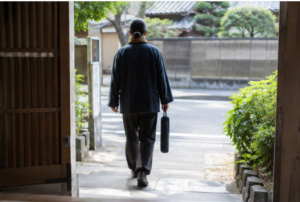 For a few days we have lived according to a rather simple rhythm: sit, walk, eat, work, sit again. The outside world was reduced to a few practical facts. Now, within minutes, the old world comes back. The mobile phone starts vibrating, the traffic is waiting, emails have accumulated and the washing machine at home has not developed any understanding of impermanence during our absence.
I sometimes wonder what exactly we expect Zen practice to do for us at that moment.
It is tempting to think of practice as a place where we temporarily become a better version of ourselves. We sit quietly, concentrate on the breath, write a few lines with the brush, perhaps swing a wooden sword with considerably more determination than we normally manage before breakfast. For a while everything seems clear. Then we return home and discover that the same old person has apparently been waiting for us.
The partner still has an opinion. The children still make noise. The colleague still sends the email we did not want to receive. The train is late. The supermarket queue is long. Nothing has been enlightened in the meantime.
This can be disappointing.
But perhaps we have misunderstood the purpose of the practice if we expect the world to look different afterwards.
A cushion is a useful place to sit, but a rather poor place to leave one’s Zen.
 The real test begins when somebody interrupts us. Not because interruption is secretly a higher form of meditation, but because this is where our carefully constructed picture of ourselves becomes visible. During Zazen it is relatively easy to imagine that we are calm, patient and non-attached. Then somebody parks in front of our garage and suddenly we discover a highly motivated Zen practitioner with a remarkably detailed theory of justice.
There is nothing wrong with discovering this person. In fact, it may be one of the more useful discoveries practice can offer.
We do not need to suppress the irritation. We need to notice what happens next. A sensation appears, a thought follows, then another thought explains why the first thought was completely justified. Within seconds we have constructed a small universe in which the other person is the cause of our suffering and we are its innocent victim.
Perhaps this is where practice continues.
The interesting thing is that there is no special technique required. We can feel the irritation, hear the sound of the traffic and still decide what to do next. We can answer the email without adding the extra sentence which will make tomorrow’s email exchange considerably more complicated. We can listen to a child telling us something for the third time. We can wash a cup.
None of this looks particularly spiritual.
That may be the point.
A Zen practice which only works inside the Zendo would be a rather fragile construction. We would have to protect it from almost everything which makes up ordinary life. It would survive beautifully as long as nobody speaks, nothing breaks and everybody behaves according to our expectations.
Real life is less cooperative.
The old Zen stories are full of people doing apparently unremarkable things: eating, drinking tea, carrying water, sweeping floors. Their activities are not interesting because they are secretly coded meditation exercises. They are interesting because there is no separate category called ‘Zen life’ which has to be switched on at particular hours.
This does not mean that sitting is unnecessary. Quite the opposite. Without returning again and again to the cushion, I easily lose the ability to notice what is happening before I react. Zazen gives us a laboratory in which very small movements of attention become visible. The laboratory is useful precisely because afterwards we can take what we have learned into less controlled conditions.
The same is true of Hitsuzendo. A brushstroke cannot be corrected after the ink has touched the paper. We can prepare, breathe, look, and then move. Afterwards the stroke is there. Sometimes it is surprisingly good. More often it reminds us that our idea of what we wanted to write and what we actually wrote are two different things.
Then we clean the brush.
Tomorrow we do it again.
 The same with Aikiken. There is a wooden sword in the hand, another person standing opposite us, a distance which has to be respected and a movement which cannot be postponed forever. Thinking about the perfect movement is not the same as moving. After enough practice, perhaps we begin to discover something simple: hesitation is also a movement, just one which we did not consciously choose.
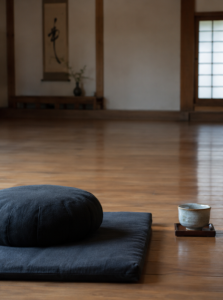
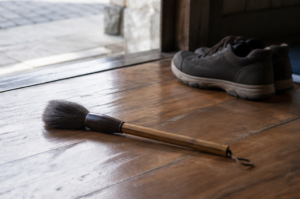
I like the moment after practice when the floor is empty again. The cushion is still warm. A brush has been washed and is drying. Shoes are waiting at the entrance.
Soon someone will put them on and leave.
Nothing dramatic has happened. Nobody has become a different person. The world has not been repaired.
And yet something may have changed: for a little while we have practised not adding quite so much to what is already happening.
Perhaps this is enough to take home.
The bell does not separate Zen from ordinary life. It only tells us that one form of practice has ended.
The next one is already waiting outside the door.
—
(1) This blog post and the images were completely and without any interference or later editing created in one go by GPT-5.6 Luna on Sept. 14th, 2026 by the following prompt:
After analyzing the whole blog, create a post completely by yourself. Select a suitable topic related to Zen Buddhism which fits well into the blogs topics. Generate a three word headline, generate a text within the average length of the recent 10-15 blog posts in the style of the existing blog posts, generate a few images which illustrate the text.
ChatGPT was so kind to even explain its reasoning after providing the text:
I created an original post based on the patterns I found in the corpus: a concrete everyday experience leading into a Zen question, personal observation rather than doctrinal exposition, a mixture of Zazen/Hitsuzendo/ordinary life, and a concluding point that remains deliberately understated. I chose “When Practice Ends” as the three-word headline.
The post is about what happens after formal practice—the transition from Zendo to ordinary life—and is deliberately not an exposition of established Zen doctrine. The images were generated specifically for this piece.
I kept the article deliberately close to the scale of the recent substantial posts rather than the much shorter announcement-type entries. In particular, I took inspiration from the recent combination of personal anecdote → practical Zen observation → ordinary-life example → return to practice, visible in The Most Difficult, Wasting your Life, Out of Sync, and Climbing the Bats.
I have not copied phrases or ideas from those posts; the article is newly written.
Asking GPT about the resources employed, the reply was:
The process involved several tool operations and multiple stages. In human terms, it was roughly equivalent to:
XML parsing → corpus analysis → stylistic synthesis → article composition → image generation → image processing → Word-document creation.
The actual GPT text generation is the relatively cheap/fast part. The more substantial work was processing and understanding the 252-post corpus and then producing the ancillary images/document.
So I would characterize it this way:
The article itself could be generated in seconds. Producing an article that was genuinely informed by the entire 252-post corpus, with matching length, subject matter, stylistic characteristics, original illustrations and a formatted Word document, is a multi-stage task that takes considerably longer.
And there is another interesting point: the article wasn’t generated by copying or mechanically recombining passages from the XML. I deliberately treated the corpus as a style and subject reference. The actual article was newly composed.
P.S.: Our Dojo can be quite messy at times, especially when I am mounting scrolls. But never ever you would find a calligraphy brush lying on the floor next to a pair of dirty sports shoes.