Zen Ken Sho – Sesshin Announcement

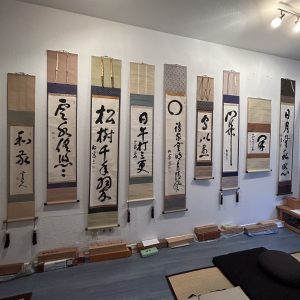
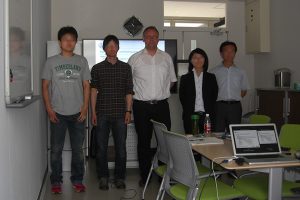
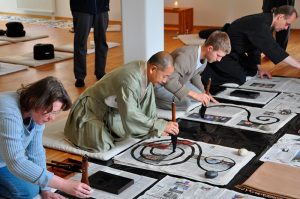
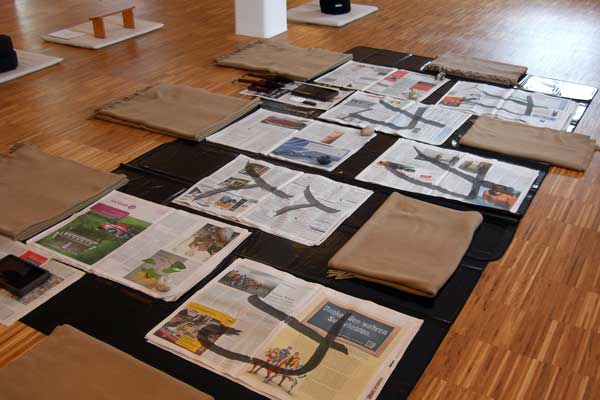
Soon (August 13-16, 2026) we will teach a 3 1/2 days Sesshin at Benediktushof Holzkirchen (near Wuerzburg/Germany). We will practice a combination of Zazen, Hitsuzendo (Zen-Calligraphy with brush and ink) and Aikiken (Aikido-based exercises with a wooden sword).

The combination of Zen-Meditation, Calligraphy and exercises with a sword was practiced already by old masters like Musashi Miyamoto, Yamaoka Tesshu and Oomori Sogen (my former teacher’s teacher).

hitsuzendoI believe that silent meditation (even if it is dynamic and strong) improves a lot when practiced in combination with creative art and physical exercise.

Through our art we can express ourselves, our Zen-experience, and eventually realise who we are. In the trace of ink we leave behind on the paper we can see our own character, our own Zen-mind.

Physical exercise is not just healthy and creating a good balance with the periods of sitting. Especially in martial arts we practice the unification of body and mind through our breathing. Decisiveness and social interaction play a stronger role than in the more solitary practice of Zazen.

Zen-Ken-Sho no Michi is a Zen-Way of exercise where we equally practice Zazen, Hitsuzendo and Aikiken.

A few places are still available, if you are interested please register for the Sesshin via Benediktushof Holzkirchen.


Climbing the Bats

“The Bat” climbing hold from TOMIK.

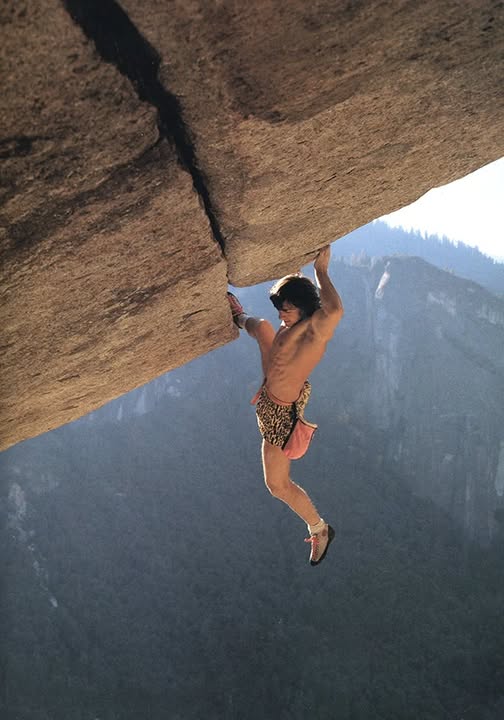
This is not about the crazy climbing posture called the “Bat-Hang”, where an experienced rock climber of supernatural power is fearlessly hanging head down from a rock secured solely by hooking the toes on a tiny hold. Some things in life I should never try, probably because I was not designed for it, or simply because that ship has sailed long ago: too old, too big, too little (time), too late. Ballet dancing for example, cosplay, romantic affairs, participating the “Rubik’s Cube World Championship”  … or sports climbing.

The legendary late Wolfgang Güllich (1950-1992), a friend of friends who lived nearby and never performed the “bat hang”.

So I decided for sports climbing. A mission impossible has always been my thing. Not because I am particularly good at doing cutting edge things and pushing the frontier of what human beings are able to perform at their best. Quite the opposite: I learn most by trying hard a thing at which I am really really bad at. Sports climbing for example.

Consequently, the other day I found myself hanging at the wall. Not head down high above the ground like a bat, but half way up at the end of my wits on what my friendly belayer (the guy holding the other end of a rope my life is hanging from in case I fall) described as a “kiddy’s’ beginner route”. My arm was loosing grip from a bat-shaped hold of the size of a small stair. Falling into the rope I caught a glimpse of my friend speeding up a 7+ route made up of little white plastic dots next to my bat-sparkled vertical playground.

A couple of weeks ago we both started climbing together, yet she is half as old, half has heavy and twice as fit as I am. And three times as bold. Now we are already years apart in climbing performance.

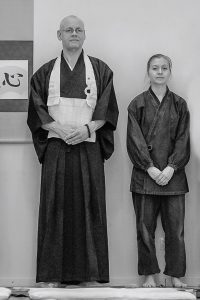
During a Zen-Ken-Sho Sesshin.

Sometimes people join our Dojo or Zen Sesshin and just feel totally wrong, intimated by what is probably perceived as the solemn atmosphere of a Japanese Temple. A big master-like looking bald-headed old man in Japanese style clothes with a golden shiny Rakuso around his neck, accompanied by his radiant young assistant dressed in a simple indigo-dyed Samu-e taking care of everything in light speed. Oh, if such first time visitor could just see us climbing next to each other at the wall, me clinging to the bats while her sending a 7+ !

Nobody is wrong. All that counts is the effort, not the outcome, not competing to others. Others are stronger, smarter, richer, younger, more beautiful. Always. The good news (the message of Zen Buddhism) is: there is no fixed self. There is nothing imprinted on us that determines us forever. Change happens anyway, inevitably, so get ahead of it and change instead of experiencing change just happen.

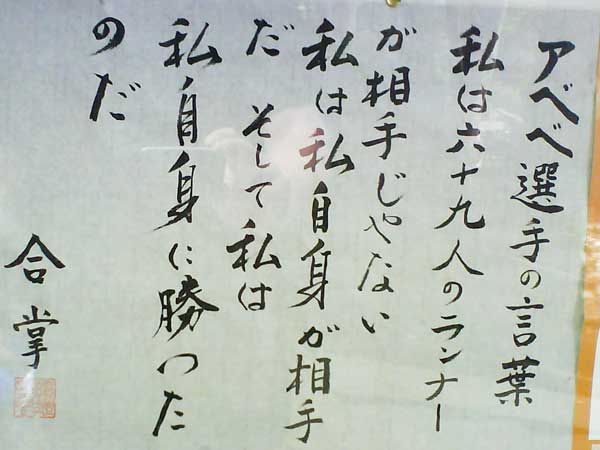
Suhara Koun’s writing of Ababe Bikila’s words.

I never mind you hardly make it into our Dojo or Sesshin, if absolutely you cannot sit on the floor and it takes half a year before you can remember how to brush the first three simple two-stroke Japanese characters. As long as you try as hard as if your life depends on it. Give your best and never give up, that’s all. That’s how I was climbing the bats the other day until I discovered the traces of blood on the wall and grips came from my fingers and knees. And never compare yourself to others, just compare yourself to the person you were yesterday, last month, last year.

Outside the Kyudo (Japanese archery) Dojo of Engakuji temple in Kitakamakura the late Zen- and archery master Suhara Koun, a friend of my former teacher, put a post:

Words of the athlete Abebe: The other 69 runners were not my competitors, I myself was my competitor. Therefore, I won against myself.

Abebe Bikila won the marathon gold medal of the 1960 Olympics in Rome running bare-feet. During the 1964 Tokyo Olympics he repeated his success (in shoes), and later in an interview spoke the above quoted words.

I imagine Abebe Kilala was a wise man. He probably understood the challenge is not about fighting others, but giving your best trying to overcome your yesterday’s self.

So never mind if you believe you are not sufficient to start practicing Zen and Zen calligraphy with us! Just imagine myself hanging three meters high above the ground on a bat-shaped grip trying very hard to climb a little better than last week, while my young friend boldly performs as a lead climber on scary rocks somewhere in the wild. Just give your very best and compete against yourself, that’s all what counts.


Wasting your Life

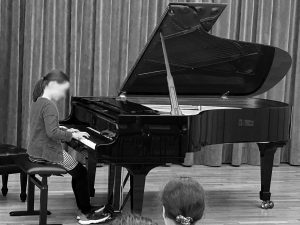
My younger daughter performing Beethoven’s Sonatine in F-Major at a students’ concert.

“Every lesson is sacred, you know I never want to cancel a single one!” my littler daughter’s piano teacher told her the other day, “You build up, lesson after lesson, thousands of hours. And each single one is so precious !”. He seemed desperate, because an upcoming class was scheduled to be replaced by some kind of “project week”, where the music school students can try out other instruments.

“Trying out instruments”, taking lessons here and there, describes well my own musical “career”. After just a few years of focused piano learning my daughter already reached beyond my poor skills on that instrument, which are the result of thirteen years not so strict teaching and a very limited approach towards structured regular practice. Well o.k., I am bad at playing a few more instruments, not just piano.

Not pressed by immediate needs to perform at our best simply to stay alive (the normal state of affairs of our ancestors), we tend to embark on some kind of random walk through life. On- and off friends, changing relationships, a bit learning this and that, a part-time job and many hobbies. It doesn’t matter, we stay alive anyway, and by posting well selected and potentially staged episodes on social media we could even convince ourselves and others of  living a happy life. It’s often a lie, and a waste of time.

When we are young, usually we want to enjoy life. I did so as well. Hanging out with random people I don’t even know any more today, spending lots of time (and some money) on romantic relationships which eventually broke up (and sometimes my heart), learning stuff at University which did not interest me but simply was part of some curriculum.

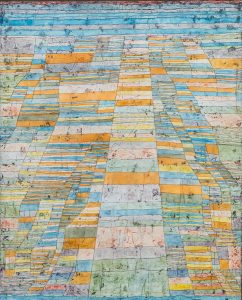
Hauptweg und Nebenwege – Paul Klee 1929 (Museum Ludwig)

Not just time passed, years, decades. Such life creates karma, that often so misunderstood Buddhist term.

Karma means that your thoughts (wishes, dreams) cause action and results in the world, for yourself and others. A few decades of random walk through life cause lots of Karma … and once you grow old enough to realise what your path through life should be, your place on earth as a human being, you might find yourself shackled down by the results of the life you lived so far: an unhappy or broken up marriage, kids you fight for custody, debt from a house you bought and maybe lost through divorce. You need to continue a job that you hate and which drains most of your time and energy just to pay for all the obligations being the Karma you produced earlier in life.

Reaching mid-forty, -fifty or -sixty, slowly becoming aware with decreasing energy levels that life might end one day,  you want to fix it. But not with giving up all the accumulated load you carried so far through life. Too little, too late! Your life is destined to continue as a random-walk, just with a little spiritual detour added to the zigzag of useless efforts and encounters.

Part of the above well describes my own experience. Part of me, fortunately, started learning from good teachers early enough in life. Teachers who were dedicated to their mission, like my daughter’s piano teacher, teachers who’s lessons were just an overflow of their life and a burning passion for their subject. So I lived a double life, partially random walk, partially dedicated to follow a path laid out by my spiritual ancestors.

It is hard work to “stay in this world”, with a job, partner, maybe family and kids, and follow a Path. Time is a precious resource, and with growing age and competence, more and more people (and institutions) are demanding your contribution and time.

Does it make sense to practice just once or twice a week? Little effort is better than none your doctor may say. But maybe it is better not to practice at all if time and energy and motivation only free two or three out of the 168 hours a week does provide! It is less than 3% of our total time, little effort disappearing in statistical noise. Isn’t it better to just have a coffee after lunch instead?

With Hozumi Gensho Roshi at Jotokuji in Kameoka (April 2014 after my ordination)

I am sure, if there is true motivation, or true pain, the time for a regular practice will be there. If you spend more time on social media than you spend at your Dojo, don’t say time does not allow you to follow your Path. It is totally up to you: after 30 years, ten thousand hours on social media, or ten thousand hours of dedicated practice (*) ?

Soon enough you will be old, your teachers gone and your life must go on without a compassionate guide at your side. It is a harsh realisation, coming much too early and often very sudden (in spite of the fact ageing is a continuous process): all those who were ahead of me, kindly guiding me through life, they are gone.

What drives me to the Dojo every day? The joy of a focused dedicated practice, at first. Never ending curiosity to try something new, or deepen my approach towards something  I have been doing for a long time. And last but not least, sheer desperation, when after spending more than half a life with Zen Arts the outcome of my work is still so poor.

It is not “me spending time for practice”, or not. Over the course of my life, I became one who is practicing. Like I am someone who is breathing, instead of spending time to breath.

Become one with your practice! Don’t waste your time. “Every lesson is sacred”.

(*) 10.000 hours means about one hour per day every day for thirty years, including some holiday.

Out of Sync

I imagine our Dojo, as it is, would be shifted 300 years back by a magic time machine (large enough to fit our Dojo in). How would that affect our practice?

For evening Zazen and Hitsuzendo we had to use candles or oil lamps. Fetching water would require us to walk three minutes down to the nearby river. That’s basically it. Nothing else would change … our exercise is timeless. Kind of.

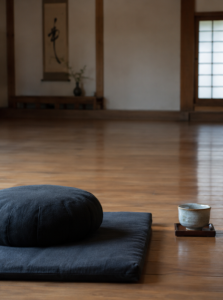
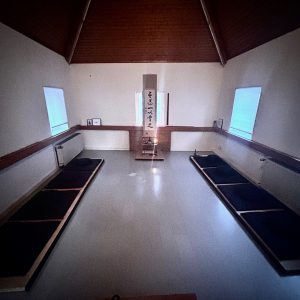
Our Dojo, empty

On the other hand side, most of the eight cushions in our Zendo remain empty most of the time. In spite of an attractive program, very few prospective new students come through the door, even fewer come back a second or third time. What we have to offer in this digital age of TicToc/Instagram/Selfie madness, the ancient practice of Zen Meditation and Calligraphy with brush and ink in the style of a more than 1500 years ago passed away Chinese master, seems totally out of time.

Du hast dich selbst überlebt, die Edlen überlebt.
Goethe, Götz von Berlichingen.

We love our practice. Every time we meet and sit together and write together with brush and ink, every time we practice Aikiken with our wooden swords we agree this is a “perfect day”. It has become our “Way of Life” over the years, and I feel most grateful towards my young student who joined me a couple of years ago,  and stayed. 

A long planned Sesshin in Bavaria this November was recently cancelled last minute, only three people registered. I wonder. What a chance missed!

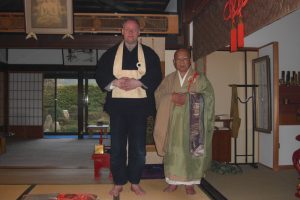
With my former teacher during a Sesshin, ca. 2009

It took me ten years to find my teacher (before the times of internet, how to search?), and ten more years studying with him, before we were teaching together. Then, side by side, for three more years, we were leading our Sesshin together. It was my younger years achievement finding a suitable teacher and learning from him. After ten more years working on my own I slowly reached sufficient confidence to share my way of practice with others.

Am I hopelessly out of sync, unable to catch up with all the benefits of our the digital 21st century? I don’t think so. In my bread and butter job I use all modern technology available, Computers, Simulation Software, AI, … my office is 100% paperless and all communication occurs digitally via my laptop. I could do my job from any place on earth with a sufficient internet connection, matching the state-of-the-art definition of a modern digital nomad.

Privately, I write letters to my friends, by hand. I enjoy conversations lasting several hours without looking once at my mobile. I remember what we talked, I think about it and I might get back to it, revising my yesterday’s opinion. I prefer listening to music real human beings perform, life on stage. And if not available, I substitute by listening to a record, or CD.

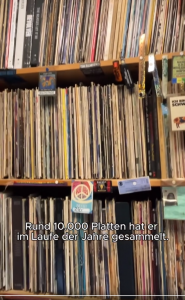
Small section of a former friend’s record collection (screenshot from a recent TV documentary)

I am old enough to remember “You want to see my record collection?” as a suitable pick-up phrase. In Murakami’s novel ノルウェイの森 (Norwegian Wood) the main character has a part-time job at a record store, and listening to a record he brought to his maybe love Naoko plays an important role in the novel (and for the title, obviously). Hard to imagine in times of streaming and endless playlists such thing could happen.

When I was in my student years,  learning something required to find someone who knows. And to make him or her spend time with you, until by and by you yourself became somebody who knows. Learning involved conversation and interaction. And even if one preferred to learn mostly by reading, having someone to recommend the next good book was indispensable (that was the most important task of a good book shop, before Amazon entered the scene). Exchange between human beings was essential.

Now we have the internet, google, Wikipedia and AI. Soon, everyone can live in his or her own personalised AI bubble: virtual friends, partners, AI generated music and movies. Everything out of the box, available 24/7 and suited according to your very preferences: the ultimate climax of loneliness.

We instead keep doing “the real thing”. At our unheated Dojo, sitting on a cushion with our own body, writing with brush and ink on real paper on the floor. Exchanging ideas we are not sure about. Trying out this or that, and most important: having a good time together. Real humans, with all their flaws and shortcomings involved in a dedicated practice of ancient Japanese arts. This is so beautiful!

If lights go off tomorrow, if the Internet and AI shuts down, we will continue. Not much change required …


Go ask Alice

The subject is probably as old as Zen Buddhism is known in the West: can psychedelic drugs potentially support or even replace Zen practice as a spiritual path? I probably cannot answer this questions from my own experience, since my drug abuse was limited to consuming moderate quantities of Franconian draft beer during my younger days. Not that I completely want to deny the mind-expanding effects of this local speciality, but long-term effects turned out to be more belly expanding than anything else.

Screenshot from the trailer of “Decending The Mountain” (1)

Recently we watched a movie (1) where random members of a small Zen group consumed psycedelic drugs in a more or less scientifically controlled framework (2), while the other part of the group stayed sober. One obvious outcome for the observer is that consuming psycedelic drugs makes it much less likely you properly fit into a group of Zen practitioners. From odd beahviour to total loss of self-control everything could be observed, but nothing which appears to make the person be more fit to participate, more likely to bring benefit to the group. You just drop out.

One pill makes you larger
And one pill makes you small
(…)
Go ask Alice
When she’s ten feet tall

– Jefferson Airplane

A lot happens in the drug induced mind. From a scientific point of view, the stimulation of psycedelic drugs is very similar, yet often much stronger, than the physiological reward system which naturally brings some “high” for us after doing sports and other joyful social activities. Taking drugs is in that sense comparable to rewarding yourself without achievement. You trick your brain into receiving some reward, without having performed anything deserving it.

This is obviously not a shortcut towards a happy life. It is like rewarding every kid with a gold medal after the race. You might feel like a winner, proudly showing off the shiny medal hanging from your neck. But in reality, all you achieved, and all you can achieve at your current condition is hardly making it to the finish line.

Jefferson Airplane あなただけを (Somebody To Love) Japanese vinyl single cover.

When logic and proportionHave fallen sloppy deadAnd the White Knight is talking backwardsAnd the Red Queen’s off with her head

– Jefferson Airplane

If your goal in life is just feeling good without reason, drugs might work out for you, at least for the time being. Zen is not about a shortcut towards “feeling good”. It is a practice making you fit for life. You might not feel like a winner, no shiny medal to be achieved. But you learn how to reach a finish line and beyond. You learn how to conduct a good life, your life. With a good teacher, a good sangha, you learn how to develop into a contributing and compassionate human being, in balance with yourself and your environment.

End of the day (or a good work-out) it might feel the same, maybe in a weaker sense, as after taking drugs. Yet, this feeling is based on some strong real-life aspect, not just on chemistry induced state of your brain, while the world around you has increasing troubles taking care of you.

This is more or less in alignment with the outcome of the above mentioned experiement. It is worth quoting the results summary of the related publication (2, bold/italics inserted by myself):

Compared to meditation with a placebo, meditators who received DMT and harmine self-attributed greater levels of mystical-type experiences, non-dual awareness, and emotional breakthrough during the acute substance effects and,  (..) greater psychological insight 1 day later. Mindfulness and compassion were not significantly different in the DMT-harmine group compared to placebo.

Taking DMT makes you feel better, mystical, more emotional, but actually mindfulness and compassion (i.e. what makes you interact with the outside world) did not change. Taking DMT actually does not make you better.

The March Hare and the Hatter put the Dormouse’s head in a teapot. Illustration by John Tenniel.

What about the creativity of artists, of musicians and writers, who often produced and performed their masterpieces under the influence of the one or other drug. Wouldn’t we miss all this outcome of exaggerated states of mind without psycedelic substances?

They were learning to draw,’ the Dormouse went on, (…); ‘and they drew all manner of things–everything that begins with an M–

– Lewis Carroll, Alice’s Adventures in Wonderland

I am very sure that someone who can produce decent art under the influence of drugs would have been able to do so even more and better in a sober state. When you can do everything that begins with an M while being high, the whole alphabet might well be at your hands when you are sober. Artists who got clean often did the better part of their work after successful rehab.

Remember what the dormouse saidFeed your headFeed your head

– Jefferson Airplane

Don’t forget the Dormouse in Alice’s Adventures in Wonderland constantly fell asleep. Even when Alice left much embarrassed about the Hatter’s rudeness …

… the Dormouse fell asleep instantly, and neither of the others took the least notice of her going, though she looked back once or twice, half hoping that they would call after her: the last time she saw them, they were trying to put the Dormouse into the teapot.

– Lewis Carroll, Alice’s Adventures in Wonderland

No, forget what the Dormouse said! You might miss Alice while she leaves, and end up in a teapot, half awake and half asleep. Go ask Alice.

(1) Descending The Mountain (2021)

(2) Meling D, Egger K, Aicher HD, Jareño Redondo J, Mueller J, Dornbierer J, Temperli E, Vasella EA, Caflisch L, Pfeiffer DJ, Schlomberg JT, Smallridge JW, Dornbierer DA, Scheidegger M. Meditating on psychedelics. A randomized placebo-controlled study of DMT and harmine in a mindfulness retreat. J Psychopharmacol. 2024 Oct;38(10):897-910. doi: 10.1177/02698811241282637. Epub 2024 Sep 27. PMID: 39340164; PMCID: PMC11487865.

The Most Difficult

Listening to a certain branch of Zen-practitioners, one could get the idea that the hardest thing in life is Zen, and the hardest thing in Zen is doing Zazen: sitting hour after hour with painful and numb crossed legs on a pillow facing the wall while fighting sleep and boredom. Alas, confusing Zen with Zazen, the sitting meditation, is widely supported by tradition. I am sure, as with any physical exercise, you can become pretty good at it if you practice hard enough, young enough with a healthy body. And if you overdo, you ruin your body and waste your time.

What did the Buddha say about the benefit of ascetic exercise? He totally gave up on it, after going to the extreme without experiencing any benefit. Following the legend, in the end he just sat down by a tree (what, by the way, is the historical origin of Zazen) and decided to do nothing more than just sitting around until he understood. It worked out, and after just seven days and nights he came up with his most profound teaching, a concept why life most of the time goes so wrong for us: the chain of dependent origination (Pratītyasamutpāda).

It all starts with not knowing (or not wanting to know), Avijjā (無明), and two and a half handful steps later ends with old age and death, Jarāmaraṇa (老死). For those who are into reciting Sutra, and namely the Hannya Shingyo, the Pratītyasamutpāda is referenced by its start- and final-link with the lines:

無無明 MU MU MYO
亦無無明盡 YAKU MU MU MYO JIN
乃至無老死 NAI SHI MU RO SHI
亦無老死盡 YAKU MU RO SHI JIN

ICHI GO ICHI E by Murase Myodoni (村瀬明道尼, 1924-2013), from our Dojo’s collection.

The intermediate links connecting not knowing and old age and death show us how it all comes together, the misery we are in, how things interact and one leads to the other (and back). One core idea within this fundamental teaching is that contact (Phassa 觸) results in sensation (Vedanā 受) and sensation in craving (Taṇhā 愛). We all know it, we all fell for the one or other advertisement, a must-have thing, or in love.

Contact – Sensation – Craving

It works in both directions, a re-enforcing feedback-loop and btw. a possible Buddhist explanation of addiction.

Craving is connected to the next link: clinging (Upādāna 取).  After you got what you were craving for, things are even getting worse: now we have it and don’t ever want letting go. “Happy ever after” is coming to my mind, “Stay as you are” or “I will always love you” (The Cure, and countless others).

Contact – Sensation – Craving and then: Never Let It Go

This is a perfect recipe for unhappiness. It makes us feel miserable with much less effort than spending years on a pillow facing the wall, guaranteed!

Where to cut this chain leading into desaster? The traditional answer is: by avoiding contact.

When I met again after many years my old friend and brother in crime for setting up an Aikido Dojo (in spite of funding and expertise) who later became a Bhikkhu (Monk in the Teravada tradition), he refused to shake hands with my spouse, even avoided coming close to her.  No “contact” allowed, because, well, we know where it ends. And my friend was an expert, having had more affairs with women (before becoming a monk) than I ever fell in love with. I long lost contact (he couldn’t stand my loose talk on Buddhist things), in case he is still alive I imagine him sitting somewhere in the East-Asian jungle wearing his orange robes, avoiding contact.

But how to prevent getting in contact with our memories? With our hardwired physical demands?

Possibly by floating in a sensory deprivation tank after being brainwashed or sedated for a total loss of memory. Not a very desirable lifestyle, after all.

If not cut the chain at the “contact”-link, where else?

Cutting “sensation”, the next link following contact, might be achieved by austere exercise destroying all sensory perception. I imagine karate students hammering their fists into wooden boards, or kung fu masters feeling no pain when hit with a stone on their forehead or stabbed by a spear. My above mentioned friend told me of his most scary experience as a monk: after accidently cutting himself he had to see a doctor, who turned out to be a female doctor. Since avoiding contact was not possible in a situation where immediate treatment was necessary, his worst fear was to feel anything. No sensation, in spite of contact … but isn’t that close to being dead? Training to feel like a corpse long before passing away? Not my cup of tea either, I will be dead soon enough and long enough for sure, no need to speed up the inevitable process by jumping to the last link right away!

What we can actively do in a healthy way is to change how we handle craving.

Sakura falling into the grass during our hanami party.

Sitting under a cherry tree in full bloom with the most pleasant company enjoying delicious food it is easy talking about impermanence and letting go. Yet asking the Sakura to stay as beautiful as today for me  forever, so I can come back day after day, enjoy the sun, the warm breeze, delicious food and company? Not even tomorrow! Everything is happening just once, 一期一会 (ICHI GO ICHI E) and it will never come back.

Enjoying moment after moment to the fullest, and then let it go without remorse and longing: this is allowing and enjoying contact and sensation without clinging. Yet this is the very hardest Zen exercise of all.

Long ago, I was sitting on my pillow doing Zazen during a Sesshin in the very town my love split up with me just a week before. Very well I could compare the pain in my knees with the pain of an aching heart. Enduring hour after hour the distress of sitting cross-legged was the easy exercise, letting go the hard one.

Practicing ENSO at our Dojo.

Kazuaki Tanahashi described the Enso (Zen circle) as “miracle of the present moment”. When we paint the Enso at our Dojo, the result is always imperfect, shaky towards the end, not round and the paper ends up being recycled.

I painted thousands of Enso and none of them was perfect. I experienced dozens of times engaging in love the wrong way and none of doing it right. One day, when I am 95 or so, I want to experience the perfect love of letting go: maybe or not have the two of us meet again tomorrow, starting from scratch exploring the miracle of the present moment. When we are together, you are the love of my life. Yet we part, again and again, without constraint and remorse and nothing more than a promise: let’s try again tomorrow, let us try even better, painting once more the imperfect Enso of our present moment.

The secret of a happy life, the very link to break the chain of Pratītyasamutpāda is: try your very best, right now, and always let it go. And this, to my limited experience, is the hardest exercise in life. It is beautiful.

avenidas y flores y mujeres y
un admirador

(Eugen Gomringer)

寝るときも
枕のしたを
水のながるる

(吉井 勇 )

Auch habe ich (..) gefunden, daß alle wirklich kluge Menschen (…)  darauf kommen und bestehen: daß der Moment alles ist, und daß nur der Vorzug eines vernünftigen Menschen darin bestehe: sich so zu betragen, daß sein Leben, insofern es von ihm abhängt, die möglichste Masse von vernünftigen, glücklichen Momenten enthalte.

(Johann Woflfgang Goethe / Italienische Reise)

As a post scriptum, a piece I wrote a year ago under the title “Love Love Love” which I never completed into a blog post:

I wish I came across Prousts “Recherches” much earlier in my life. Not that I did not know about this masterpiece, but I cherished the stupid idea to read the 4.000+ pages, preferably in the original language, once I am old an grey. All magic and illusion, all mutual misunderstanding, projection and fantasy, all pleasure and abuse of “boy meets girl” (as well as boy meets boy and girl meets girl) is laid down in this monument of French literature. All you need to know for life … before you turn 100 years.

For too many years, instead of appreciating my various affairs as magic encounters with fascinating women, I used to see it as a never ending series of failures. Just for the one reason, that non of them lasted “forever”. It took me decades of detour through the slopes and valleys of Zen Buddhism until I began to understand that impermanence is not a flaw, a failure, but the very nature of life. Nothing lasts “forever”.

The magic of love is that it “just happens”. It is unavoidable, like the weather. Suddenly sun comes out, suddenly rain. Beautiful ever changing formations of clouds, followed by blasting sun and days after days of equally dim grey sky.  I can just be there, enjoying the play of emotion or lack of, excitement and fading interest. Yet I can never get hold of it.

Your Teacher’s Karma

I’m not sure with the term “teacher” in a Zen-Buddhist context, to begin with. It is not that there is “something” to teach, a certain skill, as in Art or Science. There is no, or very little curriculum. Yet there are those elder guys, hanging around long enough and still being kind enough to share their time and experience. If you are lucky, you might find one.

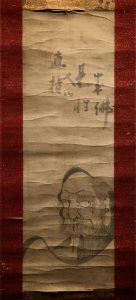
Friendly elder guy (Portrait of Bodhidharma by Hakuin Ekaku – from our Dojo’s collection).

When I was younger I spent considerable time with such elder companions. Although it was not always easy, I feel grateful towards them for allowing me into their life, more or less. Most of my “teachers”, when they were younger, started a family or engaged with a partner. Actually, I don’t remember any of them was living a celibate lifestyle. So there always was some echo from their wilder (or more conventional), younger days present, in terms of a partner, and sometimes children. In Buddhist terminology, the echo from the past, or more correctly, the past deeds or actions causing certain future consequences, are called Karma.

My late Shakuhachi teacher’s wife was kind enough to serve delicious self-made cake occasionally when I came to visit him for a lesson, while his young daughter was busy with her play-station. Kobayashi Sensei, the Japanese master who’s Aikido style we practice, used to say that he always hopes his wife will not wait for him at the Airport when he comes back from Europe. I never met her, but I vividly remember once his daughter pinning me, a young beginner at the time, on the tatami during Aikido practice. I didn’t know who she was, but couldn’t believe that tiny Asian girl had such an enormous strength.

During my stay at the rural Zen-temple in Kameoka, occasionally the Master’s wife sent us some meal she had prepared for us. In the cold and harsh environment her soup and steamed vegetables appeared to me as the most delicious Japanese food I ever had, and I imagined to taste her kindness through that meal. She must have understood how hard our life in the unheated temple was. Aside from that, I only saw her once, friendly greeting us while closing the curtain at the Master’s main temple we just visited.

Oomori Sogen Roshi with his wife and my former teacher (private picture).

There is an old picture showing my former Zen- and Calligraphy teacher together with his teacher, Oomori Sogen Roshi and the Roshi’s wife, carrying a bag while walking half a step behind between both men. I don’t remember any occasion where my former teacher mentioned Oomori’s wife, or her role or activity within the nine years he was his student.

When I married at the age of 35, I told my wife that I had been told
by a person that I respect absolutely, “Even if you starve and die, do
the right thing.” I asked her if it was all right with her. She said, “If
that’s what you say, it can’t be helped.” Though she was reluctant, I
made her consent.
– Oomori Sogen, “The Art of A Zen Master” by Hosokawa Dogen.

That sounds very much a prototype Japanese relationship of that time, and it seemed she was able to keep her tremendous suffering caused by that life-style mainly to herself.

I prefer not to share questionable stories concerning my former teacher’s wife, but for sure it wasn’t primarily caused by the teacher himself most of his students, including myself left, or were made to leave. During the 13 years I worked with him, he changed town and back, opened and closed Dojos at various locations and ended up with no students and no place to work or teach. Such a pity, he was such a good person to learn from.

Past involvement, past actions cannot be undone. Karma works, merciless, and it may cause tremendous Dukkha or suffering to oneself, without any easy way out. Yet it is the decision of each of us, and the responsibility of anyone teaching others, not to pass on that Dukkha.

Dukkha niroda, the third one of the so called “Four Noble Truths” (a terribly misleading translation of the Pali term āriyasaccāni btw.) I read more as ending and cutting of the passing on of my own Dukkha to others, not so much as bringing an end to my own suffering.

No teacher was born as a teacher, no elder companion entered the world old and wise. Once you meet such a person and get to know him or her better, you might also meet or see the results of his or her past deeds and actions, the wake of a shockingly unwise and turbulent life. Don’t judge him due to past actions or how much Karma he carries on his back. But watch out carefully how much Dukkha he or she is willing to pass on to you!

Me, Mine and Myself

Many years ago when I worked for a Japanese IT company, I remember they had a campaign for personalising their mobile-phone background design. The campaign was running under the working title “Me, Mine and Myself”. Being a proud owner of a Nokia 6150 for a couple of month at that time, I completely failed to understand what it all was about. The campaign eventually was a failure in Europe, as far as I know. Japanese technology was once more decades ahead of it’s time.

“Me, Mine and Myself” – isn’t this the ultimate source for all headache in the world? Wasn’t it the most important realisation of the person we today call the Buddha: that there is no such thing as a fixed self? Next to duhkha and anicca, he described anatta (the doctrine of non-self) as one of the three characteristics of all existence.

One thing we can truly learn when studying Buddhism, and especially when practicing Zen is that: it’s not all about Me, Mine and Myself. Less “I” makes life easier, ours, and even more the life of everyone who has to deal with us.

The other day, due to circumstances partially beyond my control, I was drawn into participating a Buddhist event. The group conducting it was very generous, welcoming everyone to join their festivity, their head monks’ Dharma Talk, Meditation and even their meal. For free. Their recently deceased head teacher called himself a Zen Master, in spite of not being related to any Japanese lineage or tradition. Zen sells, even if it is all for free.

When the event started, we all were asked to sing a song together which contained “I” ten times. We sang it 4 times (twice in German, twice in English), 40 times “I”. Followed by another song, also containing 10 times the “I”, summing up to 80 “I”s in just a couple of minutes. Eight more missing I thought …

The guided meditation following the welcome was also all about “me” … my sensation, my breath, my thoughts, my feeling in my head, my tension in my spine, my “energy” flowing down to my lower body. Not being used to constant talking while practicing mediation, the very vivid image arose in my mind of everyone constantly taking emotional selfies.

When after almost two hours we left the room, I spotted one of the deceased master’s calligraphies hanging at the wall, saying “this is it”. I couldn’t agree more, after being pumped so full with “I”. Later I had a bad night, dreaming of me, mine and myself, which resulted in that text with far too many “I”.

Maybe, this enormous emphasis on “I” and “me” is just a splendid example of upaya, the Buddhist pedagogical concept of skillful means giving everyone just the guidance to be able to understand? And what would be the best guidance for our totally self-centered selfie generation? Feed us up with even more self, so in the end we can’t stand it any more. The deceased Master must have been a genius, without doubt, drawing such a large followership and accumulating so many resources they can even generously afford welcoming someone – like me.

A Bad Religion

The other weekend we visited the Buddhism exhibition at Übersee-Museum Bremen. The focus of the exhibition was an attempt to proof that Buddhism is a religion to believe in, not something to understand. My oh my.

Was Buddhism meant to be a religion at all?

Did the person walking Indian soil more than 2.500 years ago had any intention that people over 80 generations later should worship his statue? Invent a whole pantheon of accompanying gods and spirits and mystify him as being the sheer representation of an ever lasting higher power (the existence of which, by the way, he vigorously denied)?

Exhibit at Übersee-Museum (click to enlarge).

It starts all with a good human being, an intelligent and compassionate man or women. And it ends up with well-fed elderly men (and very few women) in expensive brocade robes who succeed to impress their followers by fairy-tales of their imagined spiritual faculty or exclusive relation to godly creatures. It is called religion.

The Zen tradition as a branch of Buddhism makes no difference, and no doubt, this is a very big misconception. A fatal misunderstanding of the initial intention, with the only positive side-effect that powerful and wealthy institutions ensured to forward the message over centuries and millennia, however distorted it may appear nowadays.

Our digital generation these days enjoys the privilege of an almost unlimited access to information. We are the first generation ever who is able to easily access whatever we want to know about anything without being dependent on the goodwill of a specific person or institution. At least, in the free parts of the world.

We have all we need at our hands to dust and clean what came down to us through centuries of Buddhist tradition. Like no generation before, we can try to reconstruct what this one person we call “Buddha” did and said, as good as possible understand his intention, no matter how this or that tradition claims to convey the true story.

We have all the material at our hands. With a bit of effort we can research by ourselves how ancient texts developed into the very Sutra we maybe chant today in our local Sangha or Dojo. We can follow the development or distortion of certain ideas through the centuries. We can see how Indian Hinduism re-infiltrated Buddhist ideas. We can study how local folk religion merged with specific lines of Buddhism, for the good or the worst.

The person who spoke of himself as the Tathagata was not a Japanese Zen Master. And he did not issue any certificates to his students (just a flower, instead of). He also had no Buddha statue to worship, though he had a particular sense of humor, often making fun of the prevalent religious believes of his time and region. As far as we can know, he did not worship any gods.

Spiritual era’s gone, it ain’t comin’ back.
Bad Religion, a copout, that is all that’s left

Don’t you know blind faith through lies won’t conquer it
Don’t you know responsibility is ours?
I don’t care a think about eternal fires.

Bad Religion

Said that, possibly we should not give up all tradition and rituals. It may be helpful to have a substantial and supporting practice and a strong connection to every day life, since intellectual understanding is limited to just this: intellectual understanding. It can only serve as a map, as a cooking recipe. The action of going, cooking and eating is what counts, not of studying map after map or memorizing recipe after recipe.

Let us not be intimidated on our way by titles and brocade robes, by the dust and rubble the traditions accumulated over centuries. We may well find a treasure covered by all that scrub and layers of dirt. At least as long as we take the effort to dig deep enough and don’t forget how to use our brains instead of being satisfied with just believing in a bad religion.

Becoming McZen Teacher

After participating your first Sesshin, 5 days, 120 hours, where do you consider yourself? Already a “beginner”? Already on the Zen way? Already found your teacher and practice? I doubt.

I met my Zen teacher, with whom I worked for over 13 years, did almost 50 Sesshin, when I already was teaching Aikido at my own Dojo, offering regular Zen class (for which I mistakenly felt qualified after practicing half a decade with this or that group). It took me two or three Sesshin with this teacher to realise that I was actually a beginner, not an advanced student of any sorts. After five or six years close collaboration he made me his assistant, and after about 10 years we were teaching together.

Opening ceremony of my former Dojo near Aachen/Germany (June 2010).

More than twenty years after my first experience practicing Zazen I opened my Zen Dojo. The opening ceremony was conducted by my teacher, who gave the Dojo (and me) a Japanese name on that occasion. I received three bowls and a certificate from him that I am permitted to teach Zen and Hitsuzendo (Zen calligraphy). I remember, the first thing I did after officially becoming a “Zen teacher” was cooking noodles for all my guests.

I know who my teacher’s teacher was, and his teacher’s teacher. After parting from my teacher, I went to study with his senior colleague in Japan, Gensho Hozumi Roshi (who later “adopted” me in the Zen tradition and gave me the name “Genko”). Similar to this Zen lineage, I can draft where my late Aikido teacher came from, or my late Shakuhachi teacher. What I am doing at my Dojo is not some kind of home brew Yoga-Zen-Esoteric stuff, maybe after reading a few books or watching a few youtube videos, or spending some short (online) time with this or that self acclaimed “master”. It is totally transparent from where it all comes, and my addition is almost negligible.

Hozumi Roshi washing my feet (Kameoka/Japan).

I don’t much like social media, it keeps people away from meeting in person. But hiding my Dojo too well, I was convinced by my students, is no good idea either. So this blog exists, more or less, and a page on Instagram I occasionally update. Through this, I came about a (German language) advertisement with the title “Education: Zen-Teacher”. A program is offered, that for enormous 2.800 Euro qualifies one to teach Zen after 120-200 hours of training. Alas, not much can be found about the teacher’s qualification who is conducting the program, except that he calls himself “Sifu”, which is not quite any title known in the Zen world.

Why do such things exist? I am not interested in the particular case (that is why I even don’t provide a link here), or this or that person, if he or she exists, who invests such a great amount of cash. What interests me is the phenomenon as such.

For example, you would not find a similar advert for “becoming a violin teacher in 120-200 hours”, or “becoming a professor in quantum physics in 120-200 hours”. Why do some people believe, teaching Zen is such an easy skill to learn?

If you ask a seasoned Zen practitioner or head of a Dojo, he or she might probably even let you know that it is impossible to teach Zen at all. I tend to subscribe to that position, yet, with sufficient experience and empathy, you can be a certain help for dedicated people trying to discover their very own Zen way. Hopefully. At least, I can confirm that I benefited a lot form the guidance given by my teachers.

At a Sesshin with my student (Benediktushof Holzkirchen / Germany).

With my closest student I spent about 1.500-2.000 hours in total after she first entered my Dojo almost four years ago. If you’d ask her if she feels qualified to perform as a Zen teacher, she would probably laugh.

Do I myself feel qualified as a teacher, after almost 30 years of practice? Often I wonder. Possibly not so much. I consider myself as a borderline case: with a fascinating and profound practice to share, but very little pedagogical enthusiasm to drive someone else in a certain direction. The more you invest in your study with me, the more you might get back. But there is no “program” to join, nothing.

“There isn’t even a menu outside !” a passer-by complained after I opened my Dojo, probably mistaking it for an Asian restaurant. I like that: we don’t have a menu to order from. But you get a chance to learn how to prepare your very own Zen dish at our Dojo. It’s not McZen.