Abuse and Zen

This blog is not meant to become a kind of yellow press, and I am not much interested in denouncing certain Zen-teachers or methods of practise, just because they do things different from me.

Said that, the meanwhile well documented abuse of (mainly female) Zen students by their teachers has to be made public, in order to protect future potential victims. And the question may be asked, what kind of Zen, what kind of Zen-community or Sangha and which kind of leaders backed up those cases going on over decades. What is their understanding of responsibility?

Instead of repeating what is already widely published and discussed, below a few links for further reading considering the case of Eido Shimano, just to mention this one:

Some worth reading comments on the situation:

And eventually Eido Shimano’s letter of resignation can be found here.

Case closed? By no means! Just guess who will lead in August 2012 what is proudly announced as “the first international Rinzai Zen Sesshin ever held in Turkey” ?

It is our responsibility to prevent such obviously insane people from causing further harm, and it is our responsibility to continue teaching and practising a Zen, which supports our life and is free of abuse.

One promising step in this direction might well be to consider if it is not worth completely giving up the game of calling people “Roshi“, running behind (those who have) a “Dharma Transmission” and being blinded by names and titles … and instead focus on a teacher’s integrity, and last but not least, quality of teaching.

Zen is based on personal experience and the encounter and transmission from heart to heart 以心伝心 (i shin den shin) between true humans without a rank 無位真人 (mu i no shin nin). This is the “lineage” I follow, not any officially acknowledged yet insane “heir of Buddha”, who destroys his students.

Old Fashioned?

Martial artists often share a particular affection for the Katana, or Japanese sword. In contrast, pacifists usually express aversion against any kind of weapons. The idea that Zen has certain links to the exercise with the Katana can therefore be surprising.

Let aside historical roots of medieval Samurai performing Zen-training, more contemporary masters of Zen and sword-fighting, and a terrible misunderstanding of Buddhism by some distinguished Zen masters, leading to hilarious justifications why it is o.k. to kill …  what can the exercise with the Japanese sword provide for a western non-crazy Zen practitioner? Is it just an overcome, old-fashioned militaristic right-wing Japanese thing we better should avoid?

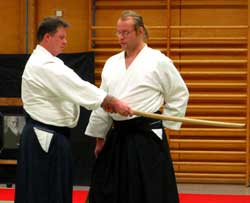
aikikenAfter the second world war, Morihei Ueshiba, the founder of Aikido, developed a new concept of practising with the wooden sword or bokken. From my Aikido teacher, Kobayashi Hirokazu, I learned this style, called otonashi no ken (音無しの剣), the silent or calm sword. There is no aggressive posture in otonashi no ken, no attack, and especially no idea of cutting down an opponent.

This bokken exercise is all about oneness with the situation, breath and timing, decisiveness and bold action in the face of a violent attack. No thought of killing or showing off with a weapon, and therefore not at all aggressive in its appearance … nevertheless, very efficient.

Although its origin is not related to Zen, I consider otonashi no ken a perfect Zen exercise. In my teaching, I want to promote this new and peaceful link between Zen and sword, giving a new and non-violent aspect to the old proverb that “Sword and Zen are One”: 剣禅一如 (ken zen ichi nyo).

Zen without Zazen

dorakuan1The other day, a reader of my blog expressed his surprise about the fact that, as he put it, I “can not imagine a Zen-life without doing Zazen”. Well, true, for myself I can not. All the Zen-Art I teach (like Hitsuzendo and Aikiken) or practise (like Shakuhachi) is based on Zazen.

It is not a big deal, sitting still in silence for some time, regularly, but in my experience,  it can make a big change for your life!

So, what about practising a Zen-Art without Zazen, or just reading Zen literature and deal with it as a kind of philosophy? For me this sounds a bit like cooking without eating, or just reading cookery books. Of course it is possible to do that, and of course it is not “forbidden” … but without Zazen, I am sure, it is much more difficult to experience the essence of Zen with your body and mind.

Said that, please feel free to call whatever of your activities “Zen”, and let’s leave the universally valid definition of “correct Zen” to the Zen-Taliban.

Qualification

The other day, I was made aware of an unlucky mail exchange between two Zen teachers, posted in this blog. Usually I am not much interested in gossip and communication gone wrong, but this discussion rises the interesting question what qualifies someone to be a Zen teacher.

In addition to my earlier comments (“The Hidden Master”, “Teaching Zen” and “Licensed Pilots, and other Things”) on a similar topic, I will try to list some criteria I consider important. Hopefully, they will help you to find a good teacher, who…

  • … practised regularly Zazen for many years, and still does practise.
  • … has intensively worked with a good teacher for a long time.
  • … has gained teaching experience as student, helper and assistant teacher on many sesshin or seminars with a lot of different students.
  • … has received an o.k. (in a formal or informal way) from his teacher, that he or she is qualified to teach. 
  • … has developed a certain amount of compassion for his or her students.
  • … feels confident and happy to teach.

What I consider not sufficient, even not at all important to judge a Zen teacher’s qualification, is his or her…

  • … nationality. 
  • … success in the “Japanese Zen-Monk Look-Alike Competition”.
  • … monastic status or position within an organisation.
  • … teaching license, issued by some authority.
  • … title (such as “Master”, “Roshi”, “Sensei”, ….).
  • … business concept, driving the students into a ranking- and career system. 
  • … number of students.
  • … number of Zen-books published.

Don’t let you fool by shiny titles or a master-like appearance, judge yourself if the person in question is a real, authentic Zen teacher, worth your dedication, time and money!

Risshun (立春)

When I take a walk across the fields outside my Dojo, at minus ten degrees these days, I can see the past and the future: big clouds of steam from the coal fired power plant on the left, and the wind wheels turning slowly on the right. Currently, I read, in Japan 50 out of 54 atomic power plants are shut down …

Today is Setsubun (節分), the beginning of spring according to the lunar calendar. Many Japanese visit their local shrines for spring celebration called Risshun (立春), and throw roasted soya beans, Fukumame (福豆) towards someone dressed as Oni or deamon to drive away the evil spirits.

Fukushima1The deputy head priest of our Dojo’s partner temple Shunkoin in Kyoto suggested angry Japanese citizens to throw beans at Tepco, the operator of the collapsed Fukushima nuclear plant. But then he wonders if beans are not too good for them … while I read that more and more leaks occur in the temporary cooling system (the experts at Tepco maybe did not consider water freezes below zero degrees), releasing tons of contaminated water, I can do nothing but agree.

This is the cycle of cause and effect, or Karma: our intentions and actions each moment have an impact on the future. Concerning atomic energy, hundreds of generations to come will suffer from the bad Karma we produced.

Zen Calligraphy (Hitsuzendo) – 1

Lesson 1 – Getting Started

In a previous post I promised to give some regular guide and inspiration for studying Zen-Calligraphy. Of course, the best option is working with a qualified teacher, but these are hard to find … so I hope my posts will help you to enjoy practising Zen with brush and ink, or Hitsuzendo (筆禅道).

Maybe you already have some basic experience with Shodo, the Japanese art of calligraphy. Maybe not … in that case I suggest you browse the web to look up some basics I won’t explain. A good introduction page is for example here, a book I can recommend is “Zen Brushwork” by Tanchu Terayama.

Next, set up a daily (or weekly) schedule, some 30 to 60 minutes for regular practise. I consider it important to exercise regularly. Say, each morning (or each other day or each Sunday), some time before breakfast … morning is better than evening!

  • Set up your place (ideally, the evening before … or keep it always ready).
  • Start with Zazen, your preferred time, 5 minutes, or 10, or 20. Don’t skip the Zazen!
  • Do a few minutes breathing exercise, Qigong, Tai-Chi …
  • Practice calligraphy for about 10-15 minutes by copying the sample a few times (details following in a next post).
  • Close with Zazen.

The purpose of Hitsuzendo or Zen-Calligraphy is not producing a nice piece of art. It is a Zen-exercise, so you can, like I do it, use newspaper to write upon, and throw the result after your practise is finished.

… to be continued.

Late Snow

snow-1The air smelled a bit like spring the last days, but this morning the garden Buddha at my Dojo was suddenly covered by snow. It is cold, and will become much colder the next days.

The plum blossom at Shunkoin, our partner temple in Kyoto, will start soon. Here winter pays a late visit. I am glad to live at a place where one can enjoy the four seasons, like in Japan. It is this same rhythm of nature, which sometimes makes us feel so surprisingly similar, in spite of all obvious differences in culture and language.

Maybe due to spring, summer, autumn and winter all the things and ideas I brought from Japan over the years blend so naturally into my 250 years old mill, now serving as a Zen-Dojo?

Studying Zen Calligraphy (Hitsuzendo)

Writing with brush and ink is an excellent Zen exercise. And it is good fun. Alas, finding a teacher outside Japan is not so easy. As a young student, I tried to copy from books with ancient calligraphies, but I usually could not figure out the stroke order, tell the difference between the various styles … and often could not make any sense of what I was writing at all.

After working with my former Japanese teacher for 13 years (and learning Japanese), I had the idea to provide what I wished to find myself two decades ago: (more or less) regular suggestions on what and how to study Zen Calligraphy, classical Zen sayings or individual characters.

brush

My idea is to post here once or twice a month a sample with some instructions and explanations. Printed out, it hopefully can serve as a template for your own studies … and maybe motivate you to come to my Dojo one day for a seminar and more intense practise!

Teragirl meets Cafee ease

teragirlSticking to tradition, secluded high up in the mountains and rejecting anyone who is not willing to give up everything is an option … opening up, finding ways to become more approachable, using the internet and trying modernisation is another one.

Said that, without a profound study and understanding of the roots of any tradition, modernisation is not possible. The outcome is otherwise a lifestyle-product, a shallow feel-good approach or fashion trend to follow, similar to buying a new outfit.

End of the day, it is all about commercialisation, whatever the promoters of the lifestyle-industry might promise, their main purpose is selling a product … find out about the latest trend of being a “Tera-Garu” (Temple-Girl) at http://tera-cafe.com/ .

Inspired by the tweet: RevTakaZen Takafumi Kawakami

寺=パワースポットてのがどうだかなぁ・・・本質を理解せずに行っているModernizationってやつだね。

Beginner’s Mind

Sometimes students ask me, if I don’t teach “advanced classes” for Zazen and Hitsuzendo. Usually, I announce my seminars as “Introduction to …” … but this is simply a trick not to scare away newcomers. We immediately do the “real thing”, that is: practise Zazen and write calligraphies with brush and ink.

Who is an “advanced student” I wonder? My Iaido teacher said “until you performed a certain exercise for at least 2000 times, you are a beginner”. Writing about 25 sheets of paper per seminar, that means you are a beginner for the first 80 or so seminars. Attending 4 seminars a year … but I don’t much like applying such measures and scales to people!

Occasionally, not often, someone coming to my Dojo does not want to learn what I demonstrate. He or she has different ideas about how to sit or how to write … and often students are physically or mentally not yet ready to learn, too much preoccupied with their own body and mind and struggling with many kinds of problems inside and around themselves. These are beginners, and I try my very best to treat them kind and carefully, not disturbing too much.

Once you made the jump and you become ready to learn, with your heart, mind and your body, progress is very quick. This I consider advanced. It is not you know more techniques or spent more years on your pillow or achieved anything special, you are just ready to learn. Some few are immediately, others might never reach what in Zen and Budo is called SHOSHIN (初心), or a “beginner’s mind”.

Well, I’d love to teach “advanced classes” for students with a true beginner’s mind! I also love to continue teaching “Introduction to …”.