Fire Monks

The title of this post refers to a book I read last week: a thrilling report about how a few monks successfully defended the Tessajara Zen Temple (a branch of the San Francisco Zen Center) in 2008 against a huge forest fire, in spite of the strict advise from the fire fighting professionals to evacuate. The Temple was founded in 1967 as the first Zen Monastery outside Asia by Shunryu Suzuki, a Japanese Zen-pioneer in the US who’s Zen-talks are collected in the highly recommended book  “Zen Mind Beginner’s Mind”.

firemonksMost things coming to my mind while reading “Fire Monks” were discussed in the book and blog which updated the community while the fire approached and passed through Tessajara:

Is it bold or stupid risking your life for preserving a few buildings? Is it a sign of attachment to one’s belongings, or non-attachment to your own life if you do such thing? Shouldn’t they not have better listened to the professional fire fighters? What a loss for the community if someone died, compared to loosing some buildings? Didn’t all this in the end prevented a fruitful re-build from scratch? Were they just lucky when surviving … and what, if not? And so on … everything is already said and written.

What really got me in the end and made me belief they were not just a bunch of suicidal Zen-freaks: eventually, those five who returned to the burning forest to defend their Temple relied on their own responsibility and authority.

Nowadays we are so quickly and willingly listening and following the advise of “experts”. Be it a health problem, financial issues or a technical question … always “out there” is someone who knows much better than me. If I ask “the expert”, he or she will let me know the verdict about my case … if I don’t follow the experts’ advise or don’t even ask for it, I am likely being called stupid and ignorant. And experts often like to tell us the way they see things is without any alternative  (“alternativlos” is my German Angst word of the year).

What can I do then, aside from finding experts and ask them how I should live my life?

What does it mean in a Zen context to defend your Temple against the firemen expert’s advise? First of all, that you do not transfer your responsibility for your life and your actions to somebody else. It is your decision, your acting and your responsibility. Ideally, you know yourself better than anyone else does, and only you can decide what is your next step, your way … no expert can tell you this! Of course you need some expertise, also the “fire-monks” acquired certain fire fighting skills through numerous drills and thorough preparations. Developing the required skills for mastering your life is part of the game, and likely a bit more work than just asking the experts … but most important is knowing yourself, and for this, years of Zen-practise provide a really good basis.

So I admire the “fire monks” not just for risking their lives and acting bravely, I respect them for taking their own decision and realising their own responsibility to act (which as well holds true for those who decided to evacuate last minute). Not handing over to the experts, but knowing yourself and being expert of your own life wherever you are, whatever your task or duty may be, is the meaning of Rinzai’s Zen-Word 随処作主 立處皆眞  (ずいしょにしゅとなれば  りっしょみなしん).

Nice Japanese Paper

For testing my condition, especially ahead of a Sesshin, I occasionally write on expensive Japanese paper I brought all the way from Tokyo. Does it make a difference, writing on a nice pure white surface, compared to the cheap newspaper I usually employ for practising? Do I stumble in my attempt to write “nicely” and not to spoil the precious paper, resulting in weak characters full of hesitation?

works

I don’t think “good” or “bad” … what I see is just me, on this picture already a week ago …

After Sesshin

Last week I shared 3 1/2 intense days with nice people practising Zazen, Hitsuzendo (Zen-exercise with brush and ink) and Aikiken (Aikido based exercise with a wooden sword) at Benediktushof Holzkirchen. I much enjoy these Sesshin, since they allow us to focus on our practise for some uninterrupted time. And particularly for me as a teacher, dealing with the various characters is always a good exercise …

Zazen and Hitsuzendo went surprisingly well without any problems. I much enjoy when I don’t have to talk too much for getting the writing periods running smoothly and there is a good concentrated working atmosphere in the room: not just when it’s my turn writing on a sheet of (news)paper, but also helping and observing the others.

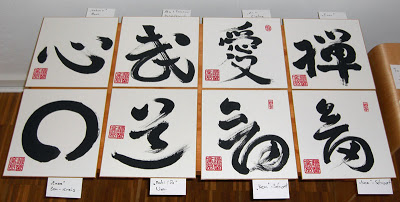
brushesSaid that, eight beginners handling wooden swords can be thrilling … so I handed out a sheet of paper the day before with written safety instructions, and repeated the main points how to avoid accidents before we started exercising. Nevertheless, one person got injured, of all participants the most experienced one with the sword (I was already looking forward to having such a skilled swordsman available for demonstration): he twist his ankle when walking down the stairs on the way back from the Dojo. My warning “most accidents happen before or after the actual practise when concentration slows down!” didn’t help … I hope he gets well soon!

After Sesshin it is once more lots of packing and un-packing at home, finally washing the brushes one more time. Always when these brushes are hanging above the sink in my kitchen slowly dripping out, I know the Sesshin is really over … and I let my concentration slip for a few minutes over a cup of tee.

P.S.: Since I got a related question: no, I am not using the soap you can see in the background of the picture to wash my brushes, only cold water! Never use soap, and warm water only if the ink dried into the hair (which ideally does never occur).

Preparing for a Sesshin

This week I will teach Zazen, Hitsuzendo and Aikiken at a three-and-half days Sesshin at Benediktushof Holzkirchen. The final round of preparation has moments when I slightly envy my colleagues who do “just Zen”: all you need to bring to a Zen-Sesshin is your tooth-brush and maybe some fresh underwear …

My preparations started weeks ago when I searched for a source to order some suitable but not too expensive bokken (wooden swords). You can spend above 100 Euro for one, or below 20 … (the below 20 are not bad at all I found).

Next is preparing a schedule: when to sit, when to practise calligraphy, when with the sword? What is a good sequence of exercises for the various participants, not boring for the young but not too demanding for the elder ones? When to have breaks?

Then Hitsuzendo: brushes, ink, suzuris, paper-weights, water-jar, canvas to protect the wooden floor from the ink and last but not least hundreds of opened newspapers to write upon have to be prepared. How much do we need? 50 kg of newspaper is what I usually bring for 10 students and three days …

Finally comes filling my car with all the things … nothing must be left behind. Once my former teacher forgot his brushes in my car when he headed to the next seminar: a big disappointment for his students (which could be partially cured by a very expensive express delivery service). Once I brought all the material for the Sesshin but forgot all my private things at home (including toothbrush) …

I guess when I get older I will teach “just Zen” … fingers crossed I leave nothing behind this week!

Bubble Tea Ceremony

Yesterday I visited an art event related to Butoh and Japanese Tea Ceremony. During a long introduction the two Western speakers confessed having not too much experiences with Japanese culture and the Way of Tea in particular, while the Japanese artist let us know she just discovered her Japanese roots after studying Western art for decades, and now wanted to promote Japanese culture in the West.

The event itself I found not particularly enlightening for a Western audience to understand the basic concept behind the Way of Tea. Performance and environment left it unclear to me how the ideas of Wa (harmony), Kei (respect), Sei (purity) and Jaku (tranquility) were intended to be exemplified by what could be heard and seen. As much as I am interested in modern versions and re-vitalisation of ancient concepts, once more I had the feeling the equation Japan = complicated and somewhat strange served as a background for an art event, which was interesting in its own but in certain contrast to the intentions of the organisers to promote Japanese culture.

Besides the chance of taking a really spooky photography,  it brought an idea to my mind…

What if, after almost three decades of studying Zen, Japanese fine and martial arts and (to a certain extend) the Japanese language, I’d suddenly discover my “Western roots” and go to Asia to teach, say, German football, F1 car racing or playing the violin …?

Ridiculous! my friends would say, you have no idea about it! Right. It is not your home country’s “cultural background”, it is not your DNA or your passport which qualifies you for expertise and skill in this or that art. It is years of study and training, of spending long time with good teachers and eventually finding your own creative way after becoming one with your art. Maybe for a few selected geniuses it is up to modernise and transfer to the next generation what they have learned from their ancestors…

Especially when it comes to Japanese art, we are too easily put off the scent by “qualification through nationality” and mislead by experts whose expertise is founded upon being born in a country they struggled to leave behind most of their adult life. What can these experts present to us? Most likely another iteration of the cliché spread about Japan in the West, since this is mainly what their understanding is based upon.

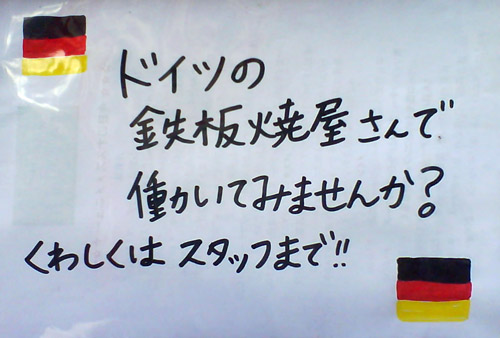
jobWhen years ago I saw this job advert in Tokyo I was tempted to apply at once, since I misunderstood someone might be looking for a German barbecue expert. Grown up in Nuremberg, I was convinced of having the Grilling Expert’s DNA in my genes for sure, and what a nice story of finding back to my Bratwurst roots I could tell to a delighted Japanese audience! But no, they wanted to hire Japanese staff for a German Teppanyaki restaurant … of all ways making something look Japanese maybe the most preposterous one, promoting a completely weird idea what Japanese cuisine has to offer to the world. Based on an early Teppanyaki experience, for years I really believed enjoying “Japanese food” means someone juggling knives in front of my nose …

As much as I appreciate and support the efforts of true experts promoting their art, beware of those who believe to know just because of the place they happen to be born. It’s not in your DNA. I can’t play football and the violin, my driving skills are poor …

Shazendo 写禅道 (Zen Photography V)

butsI have been writing much about Zen and Photography in this blog without actually showing some pictures.

My recent research on the photographer Hiroshi Moritani gave me the inspiration to develop my approach of taking pictures towards a Zen Way of Photography. I want to call it Shazendo (写禅道), in analogy to Hitsuzendo (筆禅道), the Way of Zen Calligraphy with brush and ink.

To avoid this Zen blog becoming too crowded with photographies, I started another site to show some samples of my work here: http://shazendo.blogspot.de/.

Participating Eyes (Zen Photography IV)

Photography is a great way of communication. One can tell a long story with all it’s circumstances, atmosphere and emotion in just one picture, without words.

zenLast December I found an old book at the Temple in Kameoka with fascinating pictures taken at a Zen Monastery. It was not just a documentary of the Monks’ daily life, the photographies transmitted an atmosphere of participation, as if seen through one of the fellow Monk’s eyes instead of being taken from a safe distance through a camera’s lens.

I learned that the photographer, Hiroshi Moritani  (森谷洋至), after being granted permission to shoot at the Monastery showed his initial series of work to the Master, but was turned down with “your pictures reflect you do not understand anything of our life!”. So Moritani decided to join the temple for a longer period, participate the Monks’ life and demanding daily routine, and then produced a new series of photographies, now full of understanding and compassion.

This style of Zen Photography is not observation and documentation from a safe outside position. The camera, too often creating a distance or barrier between the artist and the object, completely disappeares. Once the photographer is totally immersed in a situation, fully part of it, pictures can be taken from inside out, as looking through your eyes.

No surprise that Hiroshi Moritani is convinced that Sha-do (写道), derived from Shashin (写真, the Japanese word for photography) will be practised and accepted as an art or Way (道) similar to Shodo (書道), the art of writing with brush and ink, or Kado (華道), the art of flower arrangement (also known as Ikebana). And the same way Hitsuzendo (筆禅道) was developed from Shodo (書道), I believe a Shazendo (写禅道), a Zen Way of Photography, can emerge from Hiroshi Moritani’s Shado.

Zen Calligraphy (Hitsuzendo) – 2

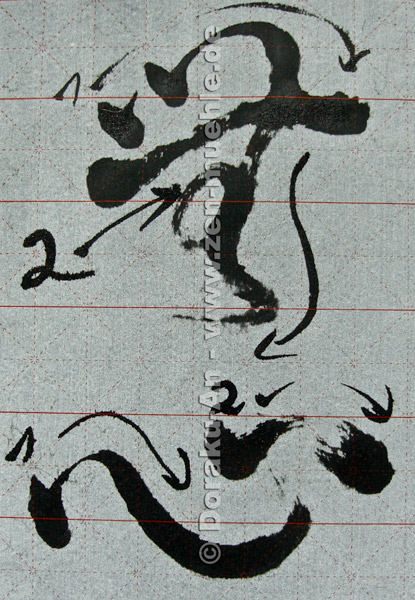
Lesson 2 – DO / michi 道

Eventually I continue with instructions for self-study of Hitsuzendo (筆禅道), a Zen-exercise with brush and ink I teach and occasionally wrote about in my blog. Before continuing to exercise with the below sample, you might want to read what I suggest for practising Hitsuzendo here and here.

Today’s character is one of my favourite, pronounced DO (in the Japanese interpretation of the original Chinese “Dao”) or michi, in kun-yomi, the Japanese way of reading it. It refers to the “way of practice” as in ShoDO (the way of calligraphy), AikiDO, KenDO, IaiDo or KyuDO (some martial arts), KaDO (the way of formal flower arrangement, also known as ikebana) or ChaDO (the way of tea, also called cha no yu).

To prepare for today’s exercise, please follow my previously posted suggestions.

The character is written in one breath, one stroke from the top left to the bottom right. The lines and numbers 1-2-3 indicate the direction, no start or stop.

DO / michi (道) – click to enlarge

DO / michi (道) – click to enlarge

Some points to consider:

  • write slowly, with breath-power, not with muscle force
  • exhale deeply and fully while writing
  • don’t rush, from start to end you might need as much as 5 seconds
  • don’t accelerate towards the end to produce and artistic effect – instead, put energy in your stroke and extend beyond the end
  • compare your writing to the sample: thick and thin, rhythm, balance, over-all impression

Today’s example is written in gyosho or cursive style, which does not much resemble it’s (more complicated) standard form.

I will post more samples later … for hands-on instructions please consider my seminars in June and November at Benediktushof Holzkirchen (near Wuerzburg/Germany).

Mushin

Thoughts over thoughts … I must prepare my lectures on supercomputing, the tax-declaration is overdue, I need to settle an appointment with the dentist, plan family holiday …

It is impossible to forget or push away all these thoughts, even during Zazen. I remember when I started practising Zazen half a life ago, sitting on my pillow often was the time when problems and thoughts hit me most severe. But with some experience, Zazen can help us not being crushed by the million issues of every day life.

mushinscrollDuring Zazen, there is no need to push thoughts away or actively stop thinking, no effort required to achieve some special state of mind. It is sufficient to sit properly, concentrate on breathing and not being bothered by the thoughts coming and going. No need to follow any idea, think about a solution for any problem coming up during Zazen. It is not necessary to concentrate on a thought in more detail, or even to ignore it.
Practising Zazen while not being the slave of my thoughts and worries is a big freedom, though it is also not a selfish ignorance of the world around me at all. When my brain stops worrying about all the issues around and inside myself, my heart can open.

I do not just sit alone with myself or with the Buddha. I sit with my partner or family maybe still asleep next door, with the birds starting to sing outside, with the early morning light and with the wind and the rain. The sounds from nature or from the street are no more different from the thoughts inside my head, coming and going. I connect to the world not by thinking about it, but by just being there, inhaling, exhaling, a bit like a kid playing or a musician …. sounds simple, but requires some praxis to work, though.

In the old scriptures this state is sometimes called Mushin (無心), which is not even half way accurately translated into “empty heart” or “empty mind”. Maybe the quaint German expression “selbstvergessen” comes closer than any English equivalence?

Zazen at Dawn

I love the quiet morning hour before dawn. My first Zazen experience in Japan, almost 15 years ago, was joining the “Gyouten Zazenkai” (暁天座禅会, Dawn Zazen Gathering) at Engakuji-Temple in Kita-Kamakura.

sculptureAfter one hour train-ride from Tokyo entering the Butsu-den (仏殿) in the surrounding nature’s cold air at dark night, and leaving the hall in early dawn after two rounds of Zazen and Sutra chanting is a very unique experience.

I remember one special morning in December, when after Zazen everything was covered with snow, and the whole Engakuji was reflecting the early morning light in a beautiful soft white. Instead of immediately leaving the Temple after Zazen, I traded in a severe scolding from the Monk at the gate for some time wandering around in the silent beauty.

Still today, I enjoy doing Zazen at dawn whenever possible. Starting a busy day with an hour of silent activity means great freedom, and it makes an enormous difference compared to rushing out of bed last second just to reach office in time.