The Special Gate

The formal architecture of a Zendo or Temple comprises a main entrance where only the Roshi is allowed to enter. On the webpage of the Tekishinjuku I read that it is “strictly forbidden” to come through this gate, so I never ever did it.

gateNot strictly forbidden seems to hang around at this Roshi’s exclusive entrance and enjoy a morning coffee, once Sutra Chanting, Zazen, cleaning and breakfast are over.

I asked K-san if the way we make use of this sunny but possibly somehow forbidden place is really o.k., and he replied with an ambiguous, “yes, maybe o.k. …”. An answer which did not fully comfort me, until one day the Roshi unexpectedly came back in the morning, and just smiled when he saw us sitting on “his” stairs enjoying the sun.

So, maybe, it is o.k. …

Bathing Day

In a Zen-temple it is not possible to enjoy a hot bath or shower every evening. The only place for a quick daily wash at our guesthouse is the old outdoors basin providing cold water, not too inviting at temperatures slightly above zero …

basinBut each couple of days (at very traditional places every two weeks) is bathing day, and today it is! After three freezing cold nights and four days wearing all the cloths I brought with me to Japan, I was much looking forward to soak myself in hot water.

Several times during my trips to Japan I stayed in lovely old onsen-ryokan where the night costs a fortune (usually neither booked nor paid by myself), with baths comprising splendid tubs from exotic wood or giant stones, filled with natural hot spring water said to have certain healing effects. But today’s bath in the Temple’s small metal tub filled with hot tap-water was without doubt the best and most joyful soak I ever had in my life!

Copying Sutra

I like Sutra chanting. Not being a great singer myself, this is a good way for me to unify breath and body through voice, together with others. But I must admit that chanting a text which is the Japanese pronunciation of a Chinese translation of something coming from India I do not really understand, is not fully satisfying.

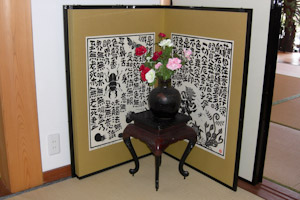
A copy of the Heart Sutra at Tokoji Temple

A copy of the Heart Sutra at Tokoji Temple

So another activity I enjoy doing here at the International Zen-Dojo during the afternoon „free practice“ hour is Sutra copying, a practise called shakyo (写経) in Japanese. For someone who likes calligraphy, this is a pleasant exercise! And a Sutra-text does not really start making sense, unless one seriously tries to discover the meaning behind it’s underlying Chinese characters, instead of just reading nonsense syllables in Latin alphabet from a sheet of paper. Even more, slowly writing the characters while rehearsing their pronunciation, helps me a lot to memorise the text.

K-san suggested I might want to offer my copy to the temple, maybe the Roshi will accept it for their collection. But it was J’s birthday the next day, and I didn’t have any present … so I had a better idea what to do with my hand-brushed copy Hannya Shingyo.

Japanese Garden (Day 4 – 29. March)

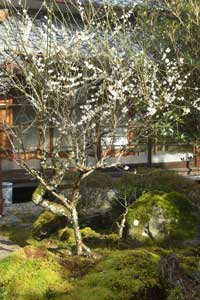
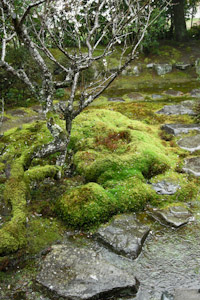
mossEver wondered why Japanese gardens look so beautiful and spotlessly clean? It is not a specific Japanese self-cleaning kind of moss, it is lots of work, day by day …

During today’s Samu, the daily working period after breakfast, we had to pick the fallen leaves and pine-tree needles from the moss and carefully pull the omnipresent weeds out. About two square meters took two of us about one hour. 

Right after rain in the evening it looked as messy as before, and we had to start all over again the next day. A good lesson about impermanence, and my aching knees let me feel once more that in Zen doing something is considered more important than any enduring outcome of our activities.  

I am sure, next time I visit Ryoanji in Kyoto I will see the vast extend of spotlessly clean beautiful moss with different eyes.

Soccer in the Zendo

After the Roshi’s demonstration how to operate the gongs during Sutra chanting, he asked us to follow him to his Zendo one more time. We did one short round of Zazen, then he wanted to explain us more about his understanding of Zen. During his lecture, the Roshi was not just sitting on his pillow talking, he accompanied his words with lots of gestures and action while walking around in his Dojo.

In the middle of his talk he suddenly opened a door under the Altar and put three footballs out. Happily he started playing around with these balls for some time until we all had to laugh, then he told us from whom he got them and so on. 

Eventually he came to the point: that emptiness in Zen, or the KU (空) in the Heart Sutra, is not “nihilism“, but more like a kind of “energy” or Ki, the basis of life. The football can jump back, although there is “nothing” inside but air, but without that “nothing” (throwing a deflated ball towards the floor), there is no energy which lets the ball jump back. The funniest and most clear hands-on explanation about the concept of “emptyness” in Zen, and the related misconception concerning nihilism, I ever witnessed …

Later K-san remarked that the Roshi is always so funny and tries to make one laugh, but sad enough we are not allowed to laugh during his talk. Well, isn’t Zen also about breaking rules? I can’t help laughing even now, when I call back to memory the image of the Roshi playing soccer in his Zendo …

Gongs and Bells

During sutra chanting there is a lot of ringing and gonging and clapping going on. It seemed almost impossible for me to learn how to do this correctly by just watching and memorising, while being busy with chanting and following countless lines of unknown syllables in the Sutra book.

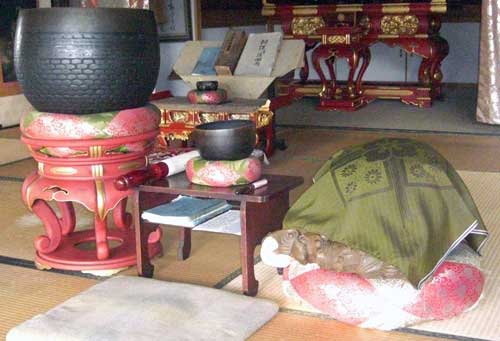
gongsToday the Roshi came to our temple while I was doing Zazen on the veranda outside the Zendo during „free practise time”. I could hear him explaining to K-san some details of how to chant and how to use the gongs properly, and he corrected and humorously imitated his way of performing today’s morning ceremony.

I politely asked K-san later, if he maybe could show me what he just learned, and he replied that it was a very unusual event, the Roshi never instructed him this way before. He let me try a bit with the big Mokugyo and the gongs, and corrected my handling and timing. “Maybe Roshi will show you later!” he concluded his lesson … a privilege I silently doubted the short-time guest to his Dojo will be granted. 

To my big surprise, in the afternoon we were sitting next to the Roshi in his temple, and he demonstrated for us in all detail how to use the gongs of different size while chanting. Several times he jokingly mentioned that foreigners cannot do this correctly. In the end he gave me a Japanese book with all relevant Sutra and explanations in, “日本語がわかる …” he said, overestimating my still far from fluent language skills. 

I am very happy about this unique chance to improve the Sutra chanting at my Dojo from the Roshi’s first hand explanation. Though I will stick to a much reduced schedule concerning the number of Sutras and length of the ceremony. Not just because I am “foreigner” … I guess it is important, next to a good performance, to also have the chance to really understand the meaning of what you are chanting. How much of your life-time you really can spend to memorise, copy, translate and deeply reflect ancient Indian texts you learned in a Japanised version of ancient Chinese pronunciation …?

Sangha

Ikkyu-san helping us

Ikkyu-san helping us

After cleaning and raking the rock garden outside his temple for about one hour, the Roshi explained to us that this kind of working together and helping each other makes us strong. In modern times, he said, everyone follows his own ideas, setting priority to the own benefit. But together we are much stronger and can live, this is the meaning of Sangha.

I must confess that my ideal image of a Zen-life often has been much closer to a hermit’s dwelling high up in the mountains, and joining other people to help or teach, or for having some fun together, was more or less an exceptional time off, if not some duty. So I always feared Sangha as a too tight community of people following some potentially repressive rules and censored ways of thinking, in cases even blindly following an abusive leader, all of this contradicting the development of a free and healthy Zen spirit and life.

I was wrong. After eating and cooking day by day, all of us together, the food donated by the local farmers, the Roshi’s simple explanation after cleaning and raking his garden made me understand … nobody can live alone.

I feel that the three of us sharing this short time at the International Zen-Dojo, together with the Roshi down at his temple, are a pretty good mini-Sangha. And gratefully I admit that we really do enjoy our days here!

Raking the Zen Garden (Day 3 – 28. March)

gardenToday the Roshi asked us to come to his temple once more. When we arrived, he was just about cleaning the rock garden (karesansui) in front of the main entrance. We helped to pick up the fallen leafs for half an hour, then he started raking a wave-pattern into the gravel.

Afterwards it was K-san’s turn with the rake, and the Roshi corrected his action with much enthusiasm and accompanying sounds. From watching K-san, I figured that raking a proper pattern into the gravel is much more difficult and physically demanding than I ever thought. Then the Roshi called me to give it a try, and I had to produce a curved line around some rocks, carefully, not to damage any of the moss.

I really liked it! Raking a Zen garden is much like Hitsuzendo, drawing a line with all your energy, concentration and breath.

Happy Birthday!

eastersToday is April 8th, Buddha’s birthday, according to the Japanese Buddhist calendar, and co-incidentally Easter Sunday. We will have a little ceremony at my Dojo, and enjoy eating chocolate eggs.

While I am still editing the notes I took at Tekishinjuku, I feel a bit sad that I was not able to stay in Japan until today. Not just I will miss the ceremonies at the temple; today also K-san will formally become a Monk and change his name.  The Roshi asked me to help K-san shave his head, but he decided to keep his hair as long time as possible … I wonder how he looks now?

What I took from Japan this time is the inspiration how to run a good Zen-Dojo, with hard practising but happy people. Maybe today is a good day to reconfirm my ideas and wishes to set up such a place, instead of longing to be in Japan?

Deserted

In May 2011, when I first wanted to visit the International Zen-Dojo, no one answered my mails. I concluded they possibly must all be too busy helping after the earthquake and tsunami, maybe all monks and residents gone to the north-east to provide their support. I even felt a bit guilty and selfish to plan a week or two doing Zazen, while in the Tohoku-region the dead are not yet buried. And in the end it was o.k., I went to Tokyo and Sendai, passing by Fukushima with it’s at this time still very unstable reactors, and visited friends and colleagues, instead of sitting on a pillow in the lovely safe countryside outside Kyoto.

Today the Roshi told me that everyone at Tekishinjuku quickly left Japan just days after the disaster happened, and the Dojo was deserted almost until last November, when K-san moved in to spend there the winter all alone. My apology that „we are always afraid“ seemed to have amused the Roshi a lot. I was not ironic when I said that, though I heard the Roshi still laughing when we left through the temple gate.

Probably I was the first person since March 2011 living in the Dojo’s guesthouse, and my task was also cleaning the room I staid, and the whole house and garden. So eventually I found one way, to hands-on help recovering from the after-effects of the disaster: preparing the Zendo for new international visitors to come.