Total Freedom

Do you remember what was driving us, when we were young? Before changing the life insurance policy and fixing the garage roof were an issue, before we started fighting about what could be an appropriate, but not too expensive return gift when visiting the Smiths?

The sky was the limit, the sky and beyond, nothing could stop us. And nowadays, we have to allocate time the next week-end to finish our tax declaration, or …

I don’t accept the priority we often tend to give to all these necessities, and also not, that giving all up and following some or any rules set up by someone leads to salvation. Our life is too short and our true friends are too few to waste our time!

winehousePractising Zazen is not, by any means not, a noble exercise which makes us somehow better, or distinguishes us from the masses wasting their lives in front of the TV or by working too hard to increase their affluence. Zazen is a way to survive, when us adult people reached a state of living in the moment, as we maybe, hopefully, once did as teenagers.

Having a heart like a child and the experience of an adult, the sky and the world are wide wide open to us, and we can freely enjoy life or burn and die so quickly.

My daughter recently called me to tell me that Amy Winehouse died. “Amy Who?” I asked … but later listening to her voice, I wished she practised some Zazen, just to survive her incredible presence for a few more years.

Two Leaves

I happened to leave London the night the riots started, which some described as a fight for new sneakers and the latest iPad, others as a consequent social explosion. Avarice, envy and frustration might be major reasons to let us do things, we normally would never accept to happen.

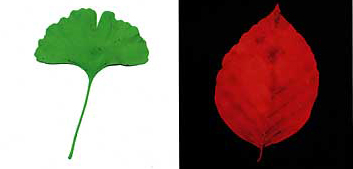
leavesMy next stop was Weimar, the cradle of what is known as the Weimar Classicism. Bach, Wieland, Herder, Goethe, Schiller, the genius pianist and generous teacher Franz Liszt, the Bauhaus opening the horizons of contemporary architecture; all of them are closely linked to Weimar, which nowadays merchandise its (at their time not always welcome) geniuses with the symbol of the ginkgo leaf, celebrated in Goethe’s well known poem.

chimney

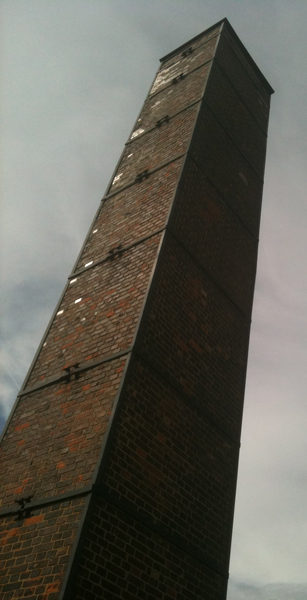
Chimney of the Buchenwald
concentration camp crematory.

Another leaf is closely linked to Weimar, that of the beech tree. The concentration camp Buchenwald is located just a Sunday afternoon coffee trip’s distance away, and within a few years as many Gentlemen were murdered in Buchenwald, as inhabitants the city of Weimar counts. The incredibly sadist way this happened filled my eyes with tears while visiting the crematory (in spite of heaving learnt all the facts many years ago at school).

How does it go together, the ginkgo leaf and the beech leaf? What answer does Zen offer?

As far as the official and approved successors of Buddha are concerned, I have not much hope. Slaughtering our Chinese brothers and sisters in Nanking, and later justifying the massacre as a good service towards their salvation, since their premature death gives them a chance to be re-born as something better, bares the same barbarian spirit of Buchenwald. The Japanese ginkgo and the German beech are brother and sister in that aspect.

What can we do?

Zen teaches us of no difference. There is not them, the evil murderers, us, the good ones. Practising Zazen also means asking myself, who is me, able to heading the Buchenwald concentration camp, slaughtering and burning myself in the crematory. Who is me, able to killing myself in Nanking.

Not taking the opportunity to rob or rape or kill the human being next to me is a cultural achievement, we should not easily underestimate. Zazen is only worth the time spent on our pillow, if it supports us in this effort, understanding me as the culprit, and the victim.

There is no “right way of living amidst the wrong” (“Es gibt kein richtiges Leben im falschen”) the German Philosopher Adorno wrote in his Minima Moralia under the impression of the fascist terror. Zen is the effort of creating a way of living, moment by moment, in spite of all circumstances. And be it nothing more than to wash our bowl after eating. Or maybe (getting back to the cause of the London riots), share some of it’s content, instead of eating all up alone.

Zen and Food

Filling the monks’ empty stomach is a very important task, so the Tenzo or chef of a Zen temple is a highly respected person. The duty of being Tenzo is for sure a good chance to develop not only one’s cooking and logistic skills, but also one’s compassion, since most of the time and energy is devoted for others’ well-being.

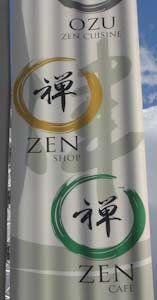
zen1That’s why I had a this-is-not-really-o.k. kind of feeling, when I discovered a restaurant (Japanese, Chinese and coffee-shop) next to the London Eye. The location is boasting with the name “Zen”, and using a (seemingly computer generated) Zen-circle (Enso) enclosing the Japanese character “Zen” 禅 as a logo.

A real touch of Zen, I experienced later in a small restaurant called “Tokyo Dinner”. It is a truly amazing little piece of Japan, located in London Cinatown. The quality of service and food is on the level (or above) of what I enjoyed in Japan (and hardly ever in Europe), at very affordable prices.

tokyodinnerNot mentioning “Zen” anywhere (and possibly even embarrassed by my comparison), you can learn about a Tenzo’s Zen-heart, when you read Tokyo Dinner’s statement “Why no tuna?”. Or if you just go there and taste yourself!

A Coup of Tea

The first ideas about Eastern Philosophy came to me through movies. There was the Star Wars from George Lucas (I wrote about in an earlier post), and as an elementary school kid I watched the TV series Kung Fu, telling the adventures of a Shaolin Monk (performed by David Carradine).

Me and my friends did not much like the fighting scenes,  since (hard to imagine today), using your feet and legs, even during most severe fights in the school-yard, was absolutely banned as being girlish and mean. But I was much impressed by the hardships the young novices had to endure, before they were allowed to enter the temple.

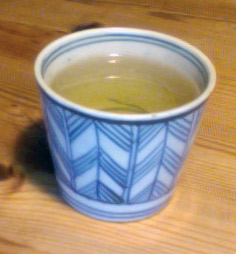
My beloved Japanese tee-cup.

My beloved Japanese tee-cup.

Especially one scene engraved in my early memory: when a few selected boys, after waiting outside the temple for days, were eventually let in and offered tea. Thirsty as they were, all kids drank immediately, all except the one, who was then allowed to stay in the temple: he waited, until the old master put up his cup …

The message, the little boy I was back then took from watching Kung Fu on TV: aside from paying a certain amount of respect, observing your seniors with full attention is the best (if not only) chance to learn something from them!

Today, fortunately, a first encounter with Zen and Zen-Arts is possible through authentic teacher, not just the TV. But watch out, when the old master offers his young want-to-be student some tea!

A Good Day ?

“Every Day is a Good Day” is a common English translation of the Japanese proverb 日々是好日 (often pronounced nichi nichi kore ko jitsu).

I came across nichi nichi kore ko jitsu around the time my interest in Zen and Calligraphy became more serious, and assumed it must describe an advanced state of mind (maybe after Enlightenment), when whatever happens to you is just good.

Alas, after years of practice, I still experienced a considerable number of bad days. I started to hate this “Every Day is a Good Day”, since it reminded me every day of my very limited progress. Not even my number of good days significantly increased!

This must be part of Orwell’s Newspeak, I finally concluded, where by erasing certain words (“bad day”) one attempts to re-define the reality, well in opposite to the obvious facts.  “Every Day is a Good Day” is simply a lie, which does not become more true when repeating it over and over again! No matter its source is the famous collection of koan, called Blue Cliff Record (Hekiganroku)

But eventually, I realised that the third Japanese character in the proverb, namely the 好 (“ko”), has a variety of connotations, aside of the usual “good”. It is often used in a sense of “to like” or “to have an intimate relation with”. Composed of the two elementary characters for “women” (女) and “child” (子), it maybe evokes the intimate relation of mother and child: an unconditional, fundamental affection, but not a statement about “good” or “bad”. Actually, (most) parents love their kids, also on days when they do something bad!

Understood this way, the 好 (“ko”) has an active component, of to like something, or to be engaged in a friendly, affirmative relation with something. It reflects my personal, emotional attitude!

Nowadays, I translate 日々是好日 (nichi nichi kore ko jitsu) as “Every Day is Welcome”, or “I Like every Day”, be it a bad or a good day!

Winning a Competition

Yesterday, the Japanese team won the women’s Football World Cup. Against whom did they win?

In case you have a chance to visit the Engakuji Temple in Kita-Kamakura, let me suggest to leave the beaten track and turn left before passing through the big wooden Sanmon-gate uphill. You will find a small sub-temple, which functions as a Kyudo Dojo (a place to practice Japanese archery).

Isn’t archery exemplary for sports competition, winning or loosing, hitting the bull’s eye or failure?

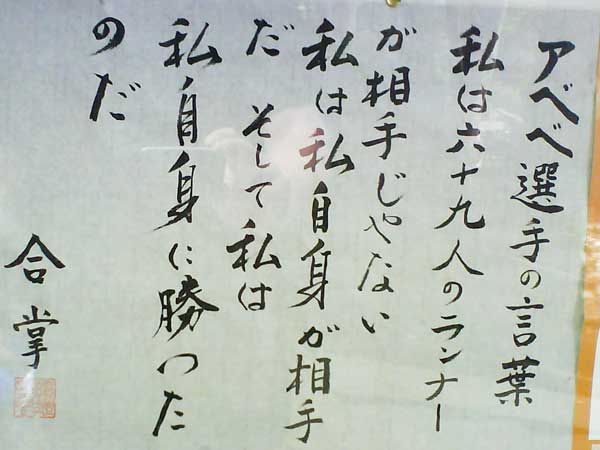
The answer is given by the head-master of the Kyudo Dojo, the old priest Suhara Koun (I was so lucky to meet and talk to several times during my visits the past decade). In the show-case right hand side after entering the Dojo grounds, he hung a newspaper article about the 1960 and 1964 Olympic marathon winner Abebe Bikila. 

abebe

Suhara Koun quoted in his own calligraphy from that article:

Words of the athlete Abebe: The other 69 runners were not my competitors, I myself was my competitor. Therefore, I won against myself.

Congratulations to the Japanese soccer team, for not giving up in the face of disaster and invincible opponents, and winning the World Cup competition against themselves!

Lost in Beauty

Gion Matsuri, one of three big festivals in Kyoto, will be at it’s peak from tomorrow on. It always makes me a bit sad, not to be in Kyoto around this time! The streets are crowded with cheerful people, you can hear the ancient festival music played everywhere from the floats, and the scent of delicious food is in the air. After the end of the rainy season Kyoto gets steamy hot with a humidity close to saturation, the typical Kyoto-in-the-summer atmosphere!

gionmatsuri

I remember strolling down Shijo-street towards Kamogawa-river with my friends, watching a dance performance, and later in the evening arriving at Yasaka-shrine next to Gion. Many many times I have been walking that route the past decade, but it is never as pleasant as during Gion Matsuri in the evening, when the streets are reserved for pedestrians, and all Kyoto seems to crowd within a few blocks of the old down-town.

Being at my Dojo in the cold and rainy north-west of Germany right now (we had 17 degrees Celius maximum today), it does not help much longing for Kyoto, for the warmth and beauty of Gion Matsuri.

Better gardening a bit in the rain, I believe, instead of dreaming of a warm festival somewhere else!  Not some other place, some other time … right here, right now is our Zen-mind! Though, still, it is so beautiful …

The More We Know

Zen is very generous: it does not require us to know or believe much. Just how to sit on our pillow in a proper and healthy posture, breath deeply and be not disturbed by thoughts and ideas coming and going, is enough. The rest is daily practice, cooking, eating, working, a social life …

A friend of mine, who became a Buddhist Monk in Thailand, recently wrote to me that I don’t understand anything about Buddhism … that Zen people anyway don’t understand enough, and how important it is to study and strictly follow all the rules defined by the historic Buddha, established over two millennia ago for monastic life in ancient India.

hesseThere are always so many people around us, who willingly share their specific view of the world: re-birth, God’s all-mighty power, Buddhas of the past, present and future, scientific and non-scientific systems of ideas and understanding, UFOs and angles, why it is important to join the fire-fighters … so much, so detailed information, down to the temperature of the hell fire and the exact amount of years until the world’s end! Catalogues of rules for conducting each detail of our daily life, telling right from wrong in any thought or action we might have or do.

Zen is also: not being disturbed too much by all these ideas (and their advocates). They are like the birds singing, my neighbour’s dog barking, the sound of wind in the trees outside my house: part of our world. Enchanting at times, annoying at others, but no need to spend too much thoughts on it!

I get up each morning, practice Zazen, Hitsuzendo, Iaido … prepare breakfast, go to office … doing all this, day by day, until the end of my life, is likely the horizon of my understanding.

The Dark Side of the Force

As a teenager, like so many of my generation, I was much impressed by the first of George Lucas’ movie of the Star Wars Series (Episode 4: A New Hope). Besides all the metaphysical super-duper power stuff and beautiful Princess Leia I loved, the possibility of drifting to the Dark Side of The Force made me think a lot.

Could it really be, that after years of studying hard all the techniques of (laser)sword fencing with the good ones, due to a bad character and unlucky circumstances, you eventually change sides and become evil? What consequences does that have for me, as a teacher of martial arts (I once was)? Is there a danger, I show a student how to use the katana (life blade Japanese sword), and he or she will use his skills learned at my Dojo to harm others?

I brought these questions to my former Iaido teacher, and his answer was quite simple:

“We welcome everyone to our Dojo who is willing learn. And especially the bad guys should be given a chance to improve their character!”

So, I understood, no need to fear that after years of working hard with a good teacher, you suddenly will turn evil and use what you have learned against others. A good teacher, and be it a fencing teacher, always offers the chance to get rid of even the worst habits acquired earlier in your life!

Said that, a certain problem (especially in martial arts) might well come through those teachers, who are focussing on technique alone, neglecting all moral and spiritual aspects of their art. They can indeed bring their students to a medium skilled, yet potentially dangerous, technical level.

The_Hidden_Fortress_posterThis is, why I especially welcome the bold and strong want-to-be Samurai from the martial arts clubs to study Zen at my Dojo! There is always a chance to learn something new …

P.S.: My interest in Star Was (and Princess Leia) vanished, after I discovered the blueprint for George Lucas’ movies, namely The Hidden Fortress (隠し砦の三悪人) by Akira Kurosawa (featuring the considerably less cute Princess Yuki Akizuki).

Zen and Science

Aside from teaching Zazen and Hitsuzendo, I am working in the field of research and education. Being a scientist is much more than just a bread and butter job, allowing me to eat and drink and have a roof over the head.

In science, we never believe anything. Whatever some authority in the field tells us, however famous the old master might be whose message the young student is supposed to hear: the first and most important thing for a scientist is not to believe!

Instead of learning a canon of old sermons by heart, take them as ultimate truth and repeat them over and over again, we must gain our own experience and re-derive and understand the contents and meaning of the words handed down from previous generations ourselves. And while doing so, we scientists by and by meet the old masters, be it Newton, Einstein, Hilbert, Curie or Crick, on eye-level.

During a scientific discussion (which can become a wild and almost violent thing, as I just witnessed on a conference last week) the ultimate call is: “Show it!” Give the proof yourself, in all detail, until I can understand it! If you fail to do so, regardless of your academic status or rank, your message is nothing worth, and be it the original and authentic words of some godfather of science himself!

No student of Physics, for example, is supposed to learn by heart, or even read, the original texts written by Newton or Einstein. He or she can get an up-to-date edition of the polished essence of Newton’s and Einstein’s work in a modern fashion, written by a splendid and possibly still active scientist, in contemporary language in any university book-store. The young scientist is expected to become able to derive, and re-formulate in his or her own words and understanding, the core of his science, in the light of the current state of the art, by himself.

By this practice, I believe, we also do a good service for our ancestors. Besides remembering their cherished names, making generation after generation truly understand, we keep the wisdom alive and ever changing!

Even more, this way of living up to the understanding of the old masters, making their experience and wisdom ours by our own hard work, and not by learning by heart and believing, is truly similar to the Way of Zen! There is nothing we are supposed to believe in, unless it is acquired through our own experience.

Even if we happen to meet the Buddha himself, if he can not show it, if we do not give our best to catch up with his level of understanding, Buddha’s words have no value for us!