To See or Not to See

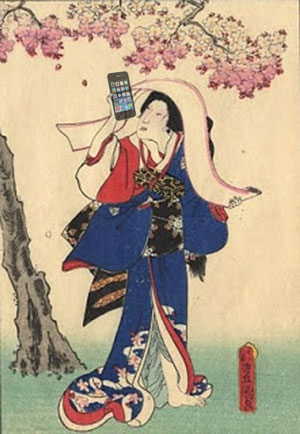
hanamiphoneCherry blossom was at it’s peak when I returned from a five days Zen-practise at Joutoku-ji in the countryside North-West of Kyoto. Once a great party appreciating impermanence under blooming trees, hanami of the digital age appears to become more and more a picture-hunting event. Not a single beautiful tree without masses of people watching it through the displays of their mobile-phones or more expensive photography equipment. There must be a billion pictures of cherry blossoms taken by the Japanese and tourists every year! Unable to simply enjoy the fleeting beauty, I couldn’t withstand the temptation of adding not just a few digital blossoms to the virtual cherry orchard.

Obai-in, a sub-temple of Daitoku-ji in the North of Kyoto had a special opening these days. The temple is famous for it’s beautifully maintained garden, one of the finest in Kyoto (designed by Sen no Rikyu), yet photography is strictly forbidden. What a relief, to enjoy the beautiful place for more than an hour until it closed, without even thinking about taking a single picture! This experience made me once more realise how much my camera sometimes obstructs what I actually could see and experience, if it was not just through a viewfinder or display.

In this week’s “ZEITmagazin” I read an interview with Elton John. I don’t know much of his music, but part of the interview addressed a similar point:

What’s all that nonsense with mobile-phone pictures? What kind of people is that who come with iPads to the concerts and shoot everything? They don’t watch the show at all, but only stare at their iPad! That’s sick!  Elton John (1)

For me it remains a tightrope walk to find the balance between photography as a Zen-way and true Zen-practise, or experience taking pictures as just getting in the way of any real experience.


(1) Interview with Elton John, “Das beste Bett aller Zeiten”, ZEITmagazin Nº 16/2014 (the English quotation is my back-translation from the German text).

Neither Monk nor Lay Person

Some time ago I wanted to attend a one-day Zazenkai conducted by Brad Warner near the place I live. I never met him, but I once read one of his books and thought it might be interesting to see him in person. It did not come true, I caught a bad flu and had to stay in bed all day long … I mention this because the on-line registration procedure for the seminar was quite remarkable: I had to specify weather I was “beginner”, “lay person” or “ordained”.

I don’t remember anyone ever asked me such question. Maybe, when leading seminars or Sesshin the participants assume I must be a “Zen Monk” because I am teaching? Or they assume I am not a “Zen Monk” because I am not Japanese, or because I still have some of my hair left and occasionally talk of my daughter? Very likely they don’t care at all about ranks and titles and are more interested in what I am saying and doing …

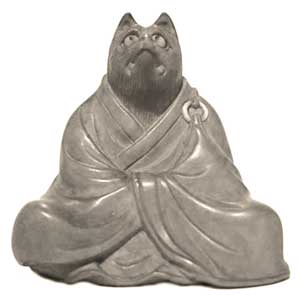
Fox, posing as Zen Monk.

Fox, posing as Zen Monk.

Recently I read an article where some American Zen teacher describes his life as an ordained Zen Monk with having a job, a family, a house, a car, a mortgage and a life insurance, very much like anyone else. I thought that’s interesting … so what does it mean then, being a “Monk”? And in addition, maybe we might need a new name for those who indeed give up all their belongings, forever leave home, shave their head, live in celibacy only from begging, and who spend all day and night in meditation, studying and teaching the Dharma?

I am not in preference of the one or other life-style, both come along with few advantages and severe hardships. Yet I have a certain feeling that imagining a “Zen Monk” busy fixing his carport roof on a free Sunday afternoon while his wife expects him to finish soon and help preparing some snacks before the members of the local school committee will come over for their monthly meeting is slightly disturbing. I imagine the same person, dressed up in a Japanese style robe during a weekend-long Zen-retreat might derive advantage from the cliché of an austere Monk having spent years in unheated Temples somewhere high up in the mountains together with his old Master, just coming down for a few days to offer his teachings.

If asked in person (and not by a web-interface), how would I respond? Living with a family, a job, having some belongings (even an old car) … yet leading Sesshin, giving Dharma talks, once receiving what is called the 10 Grave Percepts and a Dharma name, and from time to time living in an unheated Zen temple in Japan – someone who is going and sharing Ways of Zen? What is that? Cheekily I borrow a prominent testimony from an ancient Japanese Buddhist (not from the Zen branch), who described himself as “非僧非俗(ひそうひぞく)”Neither Monk nor Lay Person”. This concept is almost 800 years old … yet, for some Zen-practitioners it might provide a surprisingly fresh and honest inspiration.

Though, if forced again to select from a pre-defined multiple-choice, I’d not hesitate to chose “beginner” again …

Looking back from the Outside

Some time ago I visited an interesting Japan-related photography exhibition. During the introductory talk an eminently educated scholar related the artwork on display to avant-garde and it’s relation to different periods in the history of art, to other contemporary work, and to aspects of the ethnological approach of Claude Lévi-Strauss. He pointed out, to properly understand your own culture the view from outside is essential. For the German photographer going to Japan was a necessary precondition to develop his specific view towards his own culture.

Recently I began seriously questioning if I should not give up the more traditional aspects within my practise and teaching. Does it really make sense for us 21st century Westerners to burn incense, perform polite bowing when entering a Dojo, recite a Sutra in ancient language, maybe even wear Japanese style clothing? Is my teaching of writing Chinese characters on the floor with a big brush (Hitsuzendo) or handling a Japanese wooden sword (Aikiken) really suitable for us? Or couldn’t we sit as well on comfortable chairs and discuss over a cup of tea? Why not? Just because I spent decades with and therefore love the Japanese aesthetics so much … should my personal taste count as a sufficient argument?

I got another inspiration through the scholar’s talk at the above mentioned exhibition. Putting everything into a setting coming from a completely different cultural background, our ways of perception get re-adjusted. It is usually the task of art and poetry to present the presumably familiar in a new, unexpected or maybe shocking way. Could this approach to open our eyes and senses, this looking back from the outside at what we thought to know be helpful for understanding ourselves in a better way?

During a Sesshin or seminar conducted in a Japanese-style environment everything is new, every movement, every activity seems to make somehow sense and is yet so strange. All sensations from hearing over seeing to smelling and the perception of the body sitting on a cushion on the floor is new. A perfect condition to learn something new, to leave something old behind! Looking back from such exotic experience to my ordinary day to day life, I have a chance to discover something new in there as well. I discover patterns and structures and habits I have not been aware before, a first necessary step towards changing them.

I will stick with the Japanese Rinzai-Zen inspired approach of teaching I call Raku-Zen. It provides the precious opportunity to look at our every-day life from the outside.

A Nuclear Dukkha

gasshoToday three years ago the disastrous earthquake and tsunami occurred which triggered the meltdown of three blocks of the Fukushima Daiichi nuclear power plant. Over 300.000 people had to be evacuated, many of them for an uncertain time to be. While the dead are buried and mourned and rest in peace, the living still suffer. From beginning of April 2014 former residents of an eastern strip of the Miyakoji district of Tamura, Fukushima Prefecture, are “being allowed” to return back to their homes.

I vividly remember an evening in May 1986. I was cycling for two hours through heavy rain, and after arriving back home all soaked I heard the urgent warning on radio not to go out. A few days earlier a catastrophic disaster had occurred at the Chernobyl nuclear power-plant, some 1500 km away. Over the day the politicians’ soothing message repeating there would never be any danger “for us” was replaced by scary news of ever increasing radiation levels.

The summer was awful, friends of mine engaged in organic farming had the radioactive contamination of their grass and harvest measured and decided to discard all the milk from their cattle. Mothers were concerned about food safety and we helped them to measure radiation levels with cheap and clumsy devices, just to find occasional probes contaminated far beyond any safety limits. At playgrounds and school-yards “hot spots” of singular highly radioactivity particles were found, and I spent a significant part of my spare time explaining to an ever growing audience the scientific basics of what radio-activity is and how it can cause harm … it was a time of much fear and much confusion.

Remembering my own experiences from 1986, I feel with those who have no chance but to return to a superficially decontaminated area. The objective risk for children developing cancer later in their life is adding to the fear concerning something which cannot be sensed, only measured and reasoned. By operating a technology which can cause such harm over centuries if not millennia to come, I wonder if this shouldn’t be considered a new kind of “dukkha”? Not like the “dukkha” known under that name for 2500 years, a suffering caused by circumstances unavoidably linked to human life (birth, ageing and death) or man-made distress (greed, aversion and delusion), but a suffering from a man-made impossible future, which does not provide any hope to live “good” and “healthy” ever again? The “nuclear dukkha”.

Scientific Believers

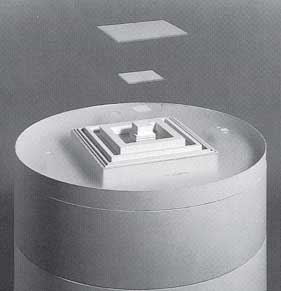
Abhidharma cosmology, section taken from (2)

Abhidharma cosmology, section taken from (2)

Recently I read a description (1) of how a young Western Buddhist tried to convince an educated Monk in the Tibetan tradition that the world is not, as the monk was sure to know, flat and square shaped with the huge Mount Meru in in it’s centre and surrounded by a circular ocean. They did not reach agreement though, and the Western Buddhist had to admit his arguments for a spherical earth were no better than those of the monk for the square with mountain.

This is a strikingly honest insight. If you lack the scientific training to either find out the way things are by yourself, or at least follow your fellow scientists’ arguments in all detail, it makes no difference if you believe the narratives of the one or the other grey-haired (or bald) wise old man or woman. In our enlightened Western society, the vast majority of people believing, for example, that the earth is spherical simply do believe so. They do not know, and even worse, they don’t even know they do not know.

The other day I received a message from Thailand. An old friend of mine who was ordained in the Theravada tradition a decade ago informed me the universe experienced 91 big bangs so far, and took this as a proof for the superiority of Buddhist wisdom, since modern science has not yet been able to confirm such ancient truth. Others try to proof their rendering of certain Buddhist beliefs by findings of modern Physics, namely Quantum Mechanics. Astrophysics and Quantum Mechanics. For a rather intelligent person it takes at least five years of dedicated full time academic study to master the basics of these disciplines … so if one takes a few random quotes from popular science literature to illustrate one’s spiritual believes, isn’t this just blending believe with believe? Like merging a square shaped earth with a spherical one and call it convergence of western science and Buddhist wisdom?

Shouldn’t maybe any serious Buddhist study nowadays begin with an undergraduate course in modern science? Just to catch up with some basics of an educated world view of the 21st century, for sharpening the mind towards a better awareness for the line separating what can be weighted and measured and what experienced by other means? And to thoroughly understand the difference between to know and to believe?

Though it might be more comfortable and soothing to just turn over and over again the prayer wheel enshrining ancient scriptures, and throw in some scientific believes here and there …

(1) Stephen Bachelor, Confession of a Buddhist Atheist, Spiegel&Grau (2010)
(2) Martin Brauen, The Mandala: Sacred Circle in Tibetan Buddhism, Shambala Publications (1997)

Silence

Well, if the two of us were to just sit here completely silent, staring into each other’s eyes … do you think I could deceive you?

Enso (around 2011)

Enso (painted around 2011 at my old Dojo)

But once we turn it into words, and then, further, when those words are written down, it gets easier and easier to trick people. Even if you aren’t looking at the person you are communicating with, it’s still possible to write things. That’s not true speaking.
 
And then, when you add computers, there’s even more possibility for cheating.

The Japanese potter, anti-nuclear organiser, anarchist, community educator and father San Oizumi, quoted in the marvellous book A different Kind of Luxury, Japanese Lessons in Simple Living and Inner Abundance by Andy Couturier.

At the Kitchen Table

table

sketch by Franz Kafka

As a young student, more than half a life ago, I shared a spacious old flat with a few endearing fellows. We spent nights and days sitting around our kitchen table with our friends and friends’ friends discussing all issues of life and death and beyond. Though, regardless which oh so important matter was at the start of our discussion marathons, inevitably we ended up with our two ever favourite topics, namely “I, me, and myself”, or “conjectures concerning others”.

One reason why against all odds I eventually completed my academic education and spent almost two decades touring around the world meeting distinguished fellow researchers lies in the observation how rare and valuable a particular characteristic of trained scientists is: the ability and willingness to discuss a certain topic to come to a conclusion sooner or later, a conclusion which for most (if not all) disputants is agreeable. That is quite the opposite of what we celebrated while sitting around our kitchen table. The development of science, I realised, is not merely a means for producing amazing machines (such as the computer I employ for writing this text), it is the endeavour stretching over centuries conducted by generations of radically honest people dedicated to successfully discuss questions towards mutual agreement.

Consequently, any attempt to pit science and religion against each other must not neglect to take into account the different traditions of communication within both fields: a doctrinal system of fixed believes imparted top down within a strictly vertical hierarchy versus a democratic culture of skilled communication producing the transient truth called science. I was recently asked:

How can you be a scientist and practice Buddhism at the same time?

No problem, my understanding of Zen-Buddhism is by all means a secular (*) one. No disposition whatsoever to trade in a polite scientific discourse against a bundle of doctrinal believes.

The only other way of communication I cherish is radically individual, not aiming at any achievement or consensus while turning the inside out: communication through art. It is not very likely I will ever again in my life join a mutual exchange at the kitchen table, even when kitchen and table are virtual installations lost in the vast space of the world wide web …

(*) my interpretation of the term secular maybe deserves some clarification, as I learned from the feed-back to this article. In an earlier version I wrote “my understanding of Zen-Buddhism is by no means a religious one”. The term “religious” apparently caused even more confusion …

I understand secular from it’s Latin root, saecularis, meaning both “worldly” and “temporal”. A secular understanding (e.g. of Zen-Buddhism) is therefore this-worldly, that means, not engaging in speculations about what was before, what will come after or what is beyond this life in this world, it is (as Zen always is) dealing with what is here and now. The second aspect temporal I read equivalent to contemporary in a way that it is up to date with science and society of the 21st century. That does not imply I completely disregard a teaching which was suitable for parts of the Indian society 2500 years ago or what developed from this root over the centuries in contact with various cultures. By no means I restrict myself to what has been said and written far away and long ago.

I am well aware there is a relatively young movement called “Secular Buddhism“. I don’t know enough about it to say if my view of “secular” and the one of the Secular Buddhists are similar, yet I have the impression there might be a certain, if not significant overlap … I explained elsewhere why I want to call what I am doing simply “Raku Zen”.

One Month of Letters

My calligraphy brushes are hanging on the brush stand, dry, collecting dust. My shakuhachi is lying in the corner, dry, collecting dust. In the morning I have been too tired and sleepy to get up early and practice Zazen, at night I am not sleeping well, and not enough … all because of reading and writing too much this month.

While working with my former teacher for 13 years I never had time for soaring flights of intellect, every moment was filled with praxis, awareness, doing. Said that, I much enjoy intellectual effort and don’t buy into the construction of some Western scholars based on the mistranslation of

 
教外別傳   a special transmission outside the teachings
不立文字   not laid down in writing
直指人心   directly pointing to the human heart
見性成佛   seeing one’s nature to become Buddha

Paco_de_Lucía_4

Paco de Lucia (1947-2014)

that Zen is an anti-intellectual approach which is totally rejecting reading and writing. Though, as soon as reading and writing starts eating up all the time and energy better spent with practise, it feels like backing the wrong horse.

Today Paco de Lucia, the master of flamenco guitar passed away with just 66 years. While listening now to his wonderful music, I feel sad … life is fragile and short, no time to waste.


Rafts and Ladders

Almost three decades ago I began to study Physics and Philosophy in an ardent quest for understanding the world. I was driven by the hope there must be an enormous amount of well organised wisdom somewhere out there which, if thoroughly acquired, will provide a proper insight into what and how things are. Everything.

The Ladder of Divine Ascent ( John Climacus)

The Ladder of Divine Ascent (by John Climacus, himself climbing ahead)

In a graduate course on Philosophy of Language I met a Professor who explained to his puzzled audience that his teaching will be more like an intellectual garbage collection, his goal is that we leave the room with less than what we brought in. We studied Wittgenstein’s Tractatus and I remember I refused to accept Wittgenstein’s idea comparing his text with a ladder we should throw away after climbing up. I wanted to have something to take home, make use of what I understood, employ the new understanding as a kind of intellectual tool-box. The idea that it just brought me somewhere else, and after getting there, I can safely forget my vehicle seemed unacceptable.

Indian woman on a raft (source: iotacourse.org)

Indian woman on a raft (source: iotacourse.org)

The Pali-Canon, the old text collection compiling what is believed to be Buddha’s words, contains a dialogue where the Buddha compares his teaching (the Dharma) to a raft. “Should I not lift this raft on my head or put it on my shoulders, and go where I like?” he asks, provoking the obvious answer: of course we should leave behind the raft “bound together by reeds, sticks, branches and foliage” (what a metaphor for the Dharma!) after we crossed the river and reached the other shore (Alagaddupama Sutta, MN22).

Once the teaching served it’s duty, we can safely leave it behind. Be it a ladder, a raft or the Dharma, no need to carry it with us …

Nevergate at the Mountain Pass

In living Zen scholarly wisdom does not play an important role. There is no intention using our clever brains to put another brick into the wall of burbling ignorance, or insert another spoke into the over-full wheel of accumulated erudition. Yet it is worth while employing scholarly wisdom to pull down such walls or pull out some spokes from weisenheimer’s spinning wheel

I vividly remember a party I visited decades ago, where someone was telling me of the “Gateless Gate”, a book full of mysterious wisdom she apparently just read. Asking about the obvious contradiction in the title, I was told Zen (she pronounced “Tsenn”) is always that way, to the outsider it sounds all contradictory. I have to transcend the “Gateless Gate”, then all issues of life will be resolved and I won’t ask such ignorant questions. Well … I decided to desert the Guardian Angel of the Gateless Gate with the excuse to get me another beerless beer, and filed “Tsenn” under “that sort of nonsense” for the time being …

Sword-Gate-Pass (劍門關) in Sichuan Province

Sword-Gate-Pass (劍門關) in Sichuan Province

Who ever had the idea to translate “Mumonkan” (無門關) with “Gateless Gate”, making Zen sound so … ohhh… mysterious and enigmatic? Let’s see how the title of this famous collection of Zen dialogues was probably meant to be understood by the author:

The last character, kan (關), means mountain pass. It evokes the image of a small and steep road climbing up the mountain to reach the other side. Such a mountain pass was of vital importance in ancient China, one had to control who comes in over the pass and who wants to escape. Therefore massive two- or three story gates, called mon (門) were often built for protecting a mountain pass. These gates or checkpoints had names patterned SuchandSuch-Gate-Pass, as Sword-Gate-Pass (劍門關), Goose-Gate-Pass (雁門關) or Strong-Gate-Pass (鐵門關).

daidomumon

大道無門

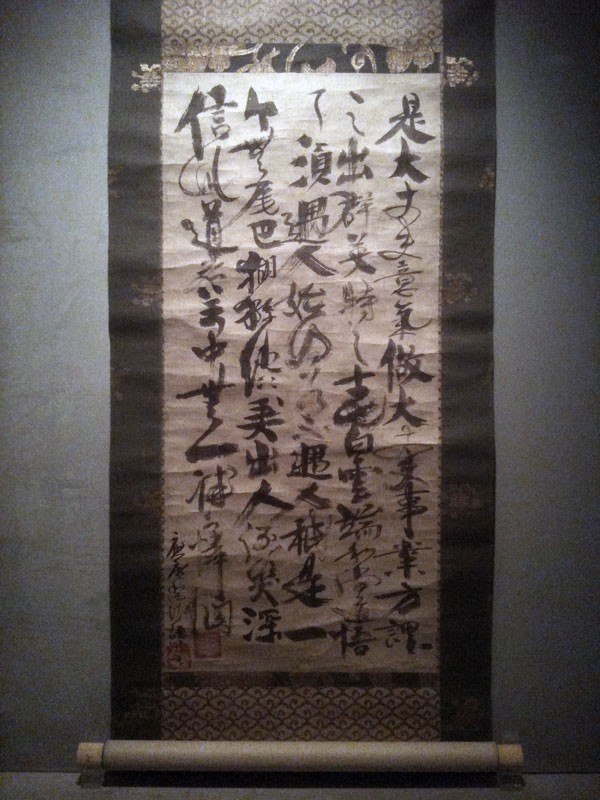
“Mumonkan” (無門關) is playing with evoking the image of such a massive gate guarding a mountain pass, and at the same time, with it’s very name Mumon (無門) saying there is no gate. Literally translating Mumonkan would read “Mountain Pass without a Gate”, yet the text in the introduction of the Mumonkan says this Mumon is the gate to the law, to the way how things are (無門爲法門). In a wonderful ambiguity which is only possible in Chinese language we are asked: “since there is [no gate]/[this gate called Mumon], how will you pass through (既是無門、且作麼生透)?” This Mumon sounds to me a bit like Peter Pan’s “Neverland”, a “Nevergate”. And it is not just the gate which isn’t there or the gate called “Mumon”, it is also Mumon’s gate, since the author’s name is Mumon Ekai (無門慧開). I can almost see him whimsically smiling …

How couldn’t we see this way (豈不見道) Mumon asks, and continues with his much quoted verse stating the Great Way (大道) is without Gate (無門), the Great Way (大道) passes through this Nevergate (無門): 大道無門.

(Not only) Scholarly Appendix: “Weisenheimer” is my ever favourite German sounding word in the English language. It is not really a Germanism, since this word is yet not (or not yet?) part of the German language. Talking of German language, the novelist Franz Kafka was telling us of just another gate in his parable “Vor dem Gesetz (Before the Law)”. Kafka’s gate to the law (法門) stands wide open and won’t be closed by the gatekeeper until the life of the very person for whom the gate was made to pass through ended, waiting outside. I read this (my ever favourite Zen story) as a warning, 豈不見道? Let’s go!