Zen Photography

Since my early teenage days I am into photography, though with several interruptions. A picture I like must be full of atmosphere, telling a story, magically transporting all the circumstances which cannot be printed on a sheet of paper: the scent of the flowers and warmth of an early spring day, the joyful activity and sound-scape of a street in Kyoto during Gion Matsuri, the smell of humid old cedar-wood and moss on a veranda facing a Japanese garden in the rain.
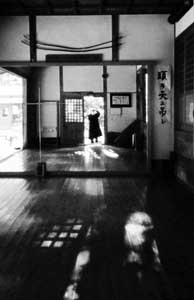
taking

Taking a picture at the Kyudo Dojo
of Engakuji Temple in Kamakura.

Aside from technical aspects (which often are ridiculously over-emphasized), I experience taking a picture very much like writing calligraphy: in this very moment I am fully present, and complete my work in one breath; not much can be improved thereafter. Most important is not being disturbed in my mindset by the action itself.

The reason why I gave up photography several times for years was that searching for nice views and handling a camera disturbed me experiencing the very situation I wanted to capture, and the wish of documenting everything became over-dominant. Doing calligraphy, you destroy your work already before the brush touches the paper if your mind is occupied by the desire to write something good.

One of my favourite photographers, Henri Cartier-Bresson, was made aware of Eugen Herrigels “Zen in der Kunst des Bogenschiessens” by his artist friend Georges Braque. Later, another famous photographer, Robert Doisneau, compared Cartier-Bressons work to that of a Japanese archer. It is not transmitted if he had in mind the aesthetic and solemn atmosphere of Zen archery Herrigel described in his book, or the wild yabusame horse riders who attempt to hit the bull’s eye in full gallop, but both images describe very well the process of taking a picture, I guess.

If you plan to go …

Maybe my notes about the seven days I spent at the Zen-Dojo near Kyoto motivated you to visit the Tekishinjuku. For me it was a very good experience, but I heard others just left after a night or two. Reading about our day to day life in my blog, a friend wrote to me “… isn’t this just stupid? I never could do it …”. So a few words in addition to the information you can find on the International Zen-Dojo’s webpage are hopefully useful:

In case you are experienced with doing regular Zazen and certain aspects of Japanese life-style (especially eating and sitting on the floor), you might enjoy your time as much as I did. Just bring a sleeping bag and a few warm cloths in case you plan to go there during the cold months.

If you are new to Zen and Japanese living and particularly eating, but want to make your first experiences in a “real Dojo”, be prepared for some hardships. The best I can recommend is to come with an open mind: everything could be a bit different from what you might expect. Just watch and learn and do … Since you will sit on the floor not only during Zazen, it is a good idea to practice a bit beforehand in order to give your body a chance to adopt to the unfamiliar posture. Zen-practise always has a strong physical aspect, part of it outside our usual comfort-zone. Especially for the beginner the focus can quickly shift from contemplation to survival. And don’t forget to bring a good sleeping-bag for the months October-May …

In any case I suggest to plan staying longer than just one or two nights, otherwise you already leave before you really arrived. If you are just looking for a cheap accommodation near Kyoto and your interest in Zen is more a touristy one, I recommend not to visit Tekishinjuku. I read a heartbreaking report on the web of a young couple who suffered two days and nights through before eventually leaving, and another one from a Shakuhachi group entiteled “Prelude to Pain“.
An excellent introduction to Zen (in English) and the opportunity to combine holiday with a stay at the Temple is offered by Shunkoin, our Dojo’s partner-Temple, which is located inside the Myoshinji Temple complex in Kyoto. Find out about Shunkoin’s weekly schedule here.

That was our daily schedule at Tekishinjuku, more or less:

4:50 Rise
5:15 Morning service
6:00 Zazen
7:00 Interior and garden cleaning
7:30 Breakfast
9:00 Manual work period
12:00 Lunch
14:00 Free practise (Zazen, Sutra copy, reading, …)
16:00 Evening service
17:00 Dinner
19:00 Zazen
21:00 Night service, retire


If you happen meet the most friendly monk K-san, who’s name is now Genryo, please don’t forget to say a warm “hello” from me!

Two Weeks

This time my trip to Japan was a bit extreme, from Kobe in the south-west to Sendai in the north-east and back. I saw the currently worldwide fastest supercomputer, went to Sendai for maybe the first scientific conference after the disaster, spent a night at an expensive Ryokan not so far from Fukushima and a week with nice people at Zen Temple outside Kyoto. I was hiking in the hills around Kamakura and enjoyed an exceptionally clear view of mount Fuji. And on the last day I attended a scientific workshop at Kyoto University, where I was happy to meet friends and colleagues from my scientific community.

fuji-1
In the plane somewhere above Siberia, I am just finishing my notes and wonder was there any specific highlight I should mention? I don’t think so, every day was a good day. I feel very grateful for all I experienced the past two weeks, and towards the people I have met. Now, I am just a bit tired …

Back to Kyoto

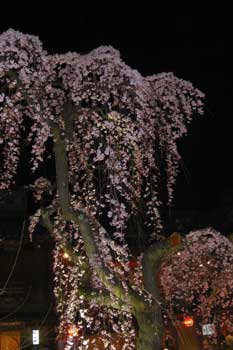
When I came back from Kameoka, I found all Kyoto busy preparing for Hanami, the cherry blossom party. In Maruyama Koen groups people happily drinking under the first cherry blossoms could be spotted, and at Hirano Jinja the booths and platforms were set up for catering the guests expected to come in large numbers the next days.

Sakura in Kyoto, May 2012

Sakura in Kyoto, May 2012

I was a bit worried how the big city would affect my mood after seven days in the Zen Dojo on quiet countryside. But it was o.k., no problem, Kyoto was for me the same as before. Just my one-tatami sized room in the old Ryokan was a bit too much luxury I felt, it even provided heating!
I enjoyed wandering around in the city, sitting at the banks of Kamogawa river in the evening, walking along Higashiyama in the east from Nanzen-ji Temple all the way to Kiyomizu-dera. Kyoto is just my second home-town, somehow, and coming home is always good …

On the last day we had a workshop at Kyoto University, which my colleagues kindly shifted for one week so I can participate. Changing from my indigo dyed samue to a black business suit, and giving a scientific presentation instead of doing Zazen and manual labour felt a bit strange at first. But the one or other way, I guess, both aspects are part of my every day life.

Leaving

When I had to go back to Kyoto after seven days I was really sad. My time at the International Zen-Dojo felt much longer than just one week, and the Tekishinjuku became a bit my home … I will miss K-san and J, our morning coffee on Roshi’s exclusive staircase, and so much more.

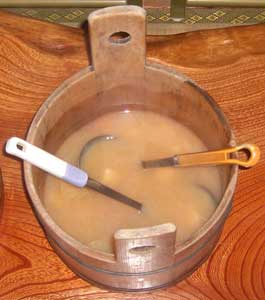
Our daily soup (with spoons)

Our daily soup (with spoons)

New guests will come and I won’t be there to help cooking. How will the polite Japanese man who arrived the other day and now moved into “my room” in the guesthouse get along with the group of tourists living under the same roof? They do not just not share the same schedule, but also not a single word of the same language? And also I did not even finish sharpening the second cooking knife … o.k., I have to let it go!

What could I learn after all, in such a short time … or was it in the end just some “Zen-tourism” I did?

Today, on the way to the airport, I found a leaflet in my pocket I must have collected two weeks ago at the Engakuji Temple in Kitakamakura. The answer to my question was written on it:

Although the spoon touches the soup every day year after year, it will never know the soup’s taste. But if you just drink one single drop, you will know the taste.

—
P.S.: A friend made me aware that the probably eldest source of the “spoon and soup” proverb is the Dhammapada, Chap.5 V.64+65. Not intending to discriminate fools and wise (or count me to the one or other group), I just wanted to say that it’s up to us to make the best out of what we find, and learn from it. Otherwise, however far you might travel, however long you might stay, whomever you might meet, chances are high “that’s a spoon ye’ll sup sorrow with yet …”

Swords at the Temple

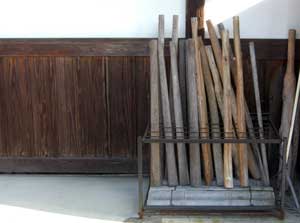
I was happy to discover a collection of huge wooden swords (suburito) behind the Temple. So I could do a few suburi or Aikiken (Aikido sword style) every day, and sometimes all of us practised together.

swordsIt is a big relief for stiff shoulders and neck to exercise with the wooden sword, and personally I like some Budo spirit at a Zen Dojo. Working with the sword is an excellent Zen-practise for a variety of reasons, therefore I also plan to teach seminars on Zazen, Hitsuzdendo and Aikiken in 2013.

On the last day we were half through with our exercise while it was a bit raining, when suddenly K-san called us across the garden wall “Roshi said we maybe can do Zazen now!” I was a bit shocked, because I did not realise the Roshi was around in the garden. So I feared he might be upset because we practised sword outside on the parking-lot, while inside the Temple he held a memorial service with some local guests who came an hour ago in very formal black suits. When I heard him say “very good” while we passed by to put back the swords, I felt much relieved. He just wanted to make us come inside because of the rain…

—
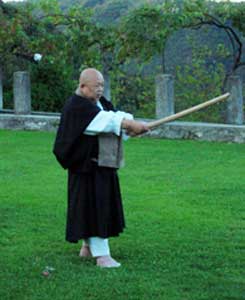
hozumiP.S.: Back home, I found this picture on the web, indicating that the Roshi likes practising with a sword himself. To my surprise he is standing in a typical “hanmi” (half body) posture, more common in some branches of Aikiken than any other more traditional schools of sword fighting.

A pity I did not ask him, aside from Omori Sogen’s Jikishinkage-ryu, where did he learn handling the sword apparently the same way I do…?

Please Translate

I have absolutely no talent for languages; achieving my current poor level of Japanese took me ten years of hard work, and I still cannot even read a newspaper. So the good news is that it is possible for everyone to learn one’s teacher’s language to a certain basic extend, and very likely in a much shorter time!

For a student in Zen and Martial Arts, speaking, hearing and especially reading are not so important,  first comes carefully observing your teacher and seniors, trying to understand and imitate what they do and why. Said that, I always thought it is a bit impolite and showing a certain ignorance towards what your teacher might have to tell you, if you do not even try to learn communicating in a language he or she feels comfortable with. If after years of being a Japanese teacher’s favourite student, all you can say his “Hai Roshi, hai …” and “Ossu”, I imagine this uses up a big deal of his infinite generosity and tolerance. And it makes you dependent on the clumsy translations performed by people like me …

This morning after the Sutra Chanting, our Dojo was full with guests, the Roshi gave a long explanation about the background of the breathing exercise he created and just performed with us, the underlying principles and the importance of developing a strong Hara. He talked once more about the unity of human beings and nature, and how important it is to have heart and body act together for being free, for which Zen provides a good background. Also he mentioned that his new temple has beams and doors higher than 1,80, extra for us Westerners … and in the middle of explaining all this, he turned towards me and said “please translate”.  That was a pretty good wakeup-call!

Cooking Rice (Day 7 – 1. April)

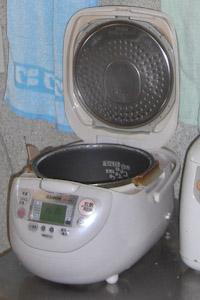
Rice is our essential food, three times a day. If we did not have an electric rice-cooker, one of us would permanently be busy in the kitchen. So, using some modern technology is maybe o.k., the more even this can provide a good lecture.

cooker-1After a few days working in the kitchen I realised that the removable inner lid of the rice-cooker has not been cleaned for possibly a very long time, so I got rid of lots of brownish-greenish smelly stuff hiding there. Also the ventilation on top did not look and smell too good, carefully speaking, and I decided to clean it the next day.

Never postpone anything to tomorrow!

Last evening J must have set up the cooker for the rice-soup accidentally with the wrong program. After morning-Zazen was finished, we found lots of water was leaking from the cooker, and this water had a really strange colour. The rice was dyed in the same strange colour, we quickly discovered … but the top ventilation I wanted to clean today was now properly washed. “Maybe strange colour, but we don’t care … still can eat rice!” K-san decided. And we had to eat it all up …

—
P.S.: I just read about the Tenzo or cook of a Monastery: “Since ancient times this office has been held by realized monks or by senior disciples who have roused the enlightened. Those entrusted with this work but who lack a disciplined mind will only cause and endure hardship despite all their efforts.” Mea culpa …

Kamemushi

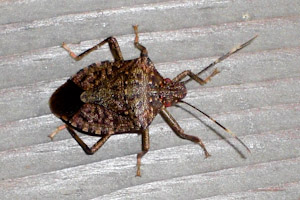
Sometimes small things make life difficult. Kamemushi for example. I wondered about the awful smell in my room after getting all dead insects out on the first day, and the smell was not completely gone a week later when I left.

As soon as we opened a window or sliding door to the veranda, the Kamemushi came in. Little bugs, who usually play dead, but become awfully stinky when being touched.

kamemushi

Sometimes I saw them wandering around in the Zendo during the Morning Service or Zazen, and K-san told me he accidentally once crashed a Kamemushi which sat on the Mokugyo, the big wooden drum-fish, during Sutra chanting.

It is not always romantic harmony, human beings and nature living closely together, and a Japanese house on countryside can be a good training ground in case you feel a bit uncomfortable with insects crawling around. The impact of small things on your Zen practise should never be underestimated…

Takuan

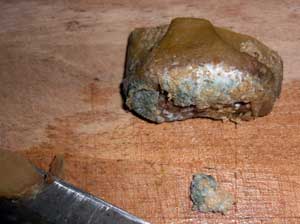
I remember I once read a funny story about the young Shunryu Suzuki, when he and his fellow monks buried some spoiled takuan (pickled radish) in the back of the garden, so they don’t have to eat it any more.

takuan

It must have been the same kind of takuan we have three times a day with our meals, and as much as I usually love takuan, I am not sure if our specific sample still fulfils all necessary requirements for being called “edible”. I imagine it is just some left-over from the Monks who deserted the International Zen-Dojo in March 2011 … but we have to eat all up!