Understanding Nature

In my today’s lecture I explained to the students what might be the most important discovery in physics within the past 100 years, the detection of the Higgs boson with the LHC at Cern in Geneva. Alas, to my disappointment, my excitement was not really shared by the future engineers and computer scientists. Partially, because I might have failed to properly summarise the underlying basics of the theory, partially, because getting even the rough sketch of what “is likely to greatly affect human understanding of the universe” is just too complicated and confusing.

cern

Doesn’t that mean that today’s theoretical description of the nature and universe is so far from our common way of thinking, that graduate scientists can hardly understand even it’s very basics? What kind of knowledge about “the universe” is it, which can only be discussed amongst a handful of experts world-wide? And, is there an alternative and satisfying way to “understand our world”, which does not require years of hard work in the field of theoretical physics?

I imagine a dialogue between a scientist (maybe at Cern) and Chao-Chou, the ancient Chinese Chan Buddhist Master:

Scientist:We just detected the Higgs boson, that indicates our theory of the Universe might be correct !
Chao-Chou: Did you wash your bowl ?

No … Chao-Chou might have asked on July 4th, 2012 “Did you switch of light ?”

Dogs and Demons

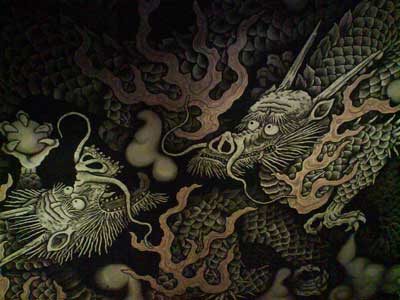
An ancient Chinese tale explains that dogs are difficult to paint because they are so common; in contrast, demons are easy to draw because they are product of our imagination. This idea I first learnt from Alex Kerr’s controversial book “Dogs and Demons – Tales from the Dark Side of Japan”.

demonThinking back, all my efforts studying Zen and Japanese Arts was a process of searching demons and finding dogs. The shiny, much appreciated, rich of impressive effects teachers luckily never crossed my way …

In Martial Arts, Zen, Calligraphy and Shakuhachi at first I was attracted by super-human power and superficial beauty, but regularly ended up with teachers following a very plain and seemingly unattractive way. No cheap effects, no glory … and no high ranks or certificates to earn.

I must admit I often was full of doubt against my teachers and secretly imitated the “demons art” while learning their plain lessons. Are they cheating me? Are they just teaching the basics year after year, and I miss any advanced lesson? Will I ever be able to do the real thing?

It took me many years to understand the secret behind dogs and demons. The plain calligraphy, the sober Aikido and Iaido style I learnt, the frugal Shakuhachi and most of all a simple approach to Zen and every day life is all I want to practise and teach nowadays. Nothing but dogs …

Too many Roses

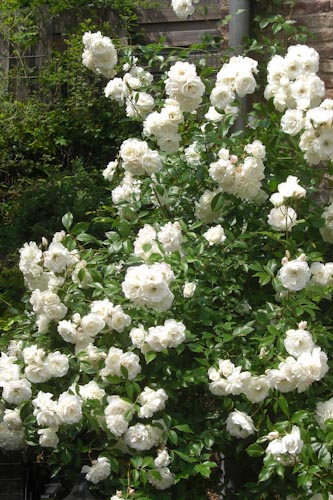
rose-1My house and Dojo is filled with the fragrance of roses. Just outside the kitchen window stands an old rose bush, meters high and in full blossom. I only have to open the window to enjoy the view and let the odour in. The rose survived last years pre-mature spring (with a second blossom in autumn), this winter’s most severe frost (which destroyed my bamboo and maple tree), and even a lightning stroke a few weeks ago. In size and beauty it easily matches those examples I appreciate so much in the courtyards of some old Oxford colleges.

Until yesterday. My neighbours cut the rose down and dug the roots out, they said it was “too large”, the falling petals were producing “too much of a mess” and the whole appearance was “too disorderly”. Very sad, I collected some blossoms from the ground and put them in a bamboo vase I produced last week from a rod left over after making a Shakuhachi.

This unreasonable act of destruction reminds me of an episode with the tea master Sen no Rikyu, who once destroyed all morning glories in his garden just to display one single blossom during a tea ceremony with Toyotomi Hideyoshi. I must admit, I never much liked this tale … though we can maybe learn from it that “too much” of something is always at risk.

I guess it is time to leave this place for good …

Boredom and Wandering Mind

As beginners of Zazen most of us went through a similar experience: after the first excitement about the new discovery vanished and we learned to master the leg-pain which kept us busy the first half year or so, we sit on our pillows fighting sleepiness, boredom and a wandering mind.

A good practise maintained (and possibly with the support of a good teacher), after some time we learn to benefit from regular Zazen and appreciate the time sitting on our pillow, instead of just waiting for endlessly long minutes to pass by (change your teacher, if you got stuck here for years!).

For many years, though, I was unable to transfer my positive Zazen experience into playing the Shakuhachi. While sitting Zazen felt very o.k., I was often bored and tortured by a wandering mind when practising Honkyoku, and hoped to reach the end of a long ancient piece to come soon while playing. It almost drove me mad to realise how difficult it was to take something of my Zen experience into “daily life”, and be it just another Zen exercise.

What made me not give up were the lessons with my teacher. Physically and intellectually very demanding and never boring hours, each time I saw and heard him play or played together with him I was once again sure where this way can lead me, if I just keep on going.

These days, playing the Shakuhachi or Kyotaku and sitting Zazen is the same for me, no difference at all … but it was a very long way to get there. Thanks to this experience I consider it so very important to study a Zen-Art in addition to just sitting Zazen. It gives us the chance to learn how to expand Zen to every day life, and it provides us with a qualified and maybe sobering feed-back about how deep or shallow our Zen experience really is.

The False Bell

The ancient name for the Japanese bamboo flute Shakuhachi is Kyotaku (虚鐸), which means “false bell”. Legend has it that the Chinese Monk F’u Hua Ch’an Shih was ringing a bell when he went begging. His want-to-be student Chang Po, though being rejected by F’u Hua Ch’an Shih, tried to imitate the sound of the bell with his bamboo flute.

"Suizen", Myoanji/Kyoto

“Suizen”, Myoanji/Kyoto

I consider the idea quite inspiring that the Shakuhachi origins from the imitation of a bell by a rejected student, though nowadays it is believed this legend was just made up by the Komuso, the Shakuhachi playing monks of the Fuke sect.

While the modern Shakuhachi, which developed since the Meiji era, is just for musical performance, the ancient sound of the Kyotaku can still be heard at hidden places. Many of it’s followers insist their practice of the original pieces, the Honkyoku (本曲), is some kind of prayer and never for public performance.

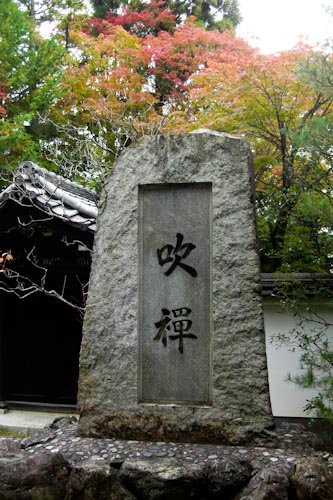
In my Dojo, playing the Kyotaku is performed as “Blowing Zen” (Suizen 吹禅) practice, and instead of reciting Sutra after Sutra. Said that, I believe that like the music of J.S. Bach, which extended beyond its original religious purpose in Western culture, the Kyotaku has a similar potential. Be it a prayer, a Sutra recitation or just music, the sound of the Kyotaku is able to directly touch the listeners heart, independent of his or her religious or cultural background.

Overcoming Difficulties

When my daughter was little, she insisted doing everything on her own before she was actually able to do it … dressing up, closing shoe-laces, climbing up and down the stairs. No parent’s help allowed! All kids are like that: looking out for new challenges and expanding their skills by overcoming difficulties.

Becoming adult, many of us loose that attitude, and we spend considerable effort into making our environment and things and tools of our daily life as easy to use and comfortable as possible. The sad extreme is someone who is best at operating the TV’s remote control while lying comfortably on the sofa, eating ready-made food.

A significant part of practising Zen or Zen-Arts is overcoming difficulties. Why do we sit on a pillow instead of a sofa, why do we use an ancient brush instead of computer software to write and draw. Why is Budo training so close to pain, sweat and tears? And why is Suizen (“blowing Zen”) practised with a rough seven-hole bamboo stick instead of perfectly tuned and easy to play modern Shakuhachi or silver flute?

We learn new things and grow only with overcoming difficulties, and by that we become more and more free and independent from random circumstances. The deep essence of Zen is no-ego … that suffering, nerve-wrecking needy “I” “I” “I”, which does not feel comfortable until the whole world around is modified to meet it’s requirements vanishes … and one day everything what just comes along is good.

Though, it requires a bit of a kid’s enthusiasm and focussed effort to get there, or “Zen-training”, as we adults like to call it …

Flute Making

When I started learning how to play the Shakuhachi about thirteen years ago, I got the impression it is not much more than a roughly cleaned stick of bamboo with seven holes: one on top, one on the bottom and five finger holes. And it is terribly difficult to produce any proper sound with it, if not any sound at all. I was shocked how much this very expensive flute I got from my teacher failed to match any criteria for a proper musical instrument I for example saw perfectly fulfilled by my cherished Selmer saxophone.

It took me ten years to understand why the seemingly imperfection of the Shakuhachi I struggle to play makes it so suitable for my practise, and why the modern Shakuhachi, designed considering the complicated physics of sound generation and therefore easy to play, do not.

Recently I started making Shakuhachi myself … just rough bamboo sticks with seven holes. They sound very much like my teachers flute, yet they are a bit too easy to play. I guess I have to impair their musical quality, to make them good instruments for Zen practise.

Playing Shakuhachi

Most of my spare time these days I spend practising Shakuhachi, the Japanese bamboo flute. From all the instruments I play, I love the Shakuhachi most. Its rough and yet refined sound is closest to nature, like the wind going through a bamboo grove.

shakuhahi
Whenever possible I play with the windows of my Dojo wide open, so the singing of the birds outside nicely merges with the sound of my flute. I feel the birds’ voice is very inspiring for my play.

The other day I woke up from birds’ singing which sounded much like the imitation of my Shakuhachi. HO-U HO-U RU-RU … I wonder, maybe the inspiration is both ways?

Make Art not War

“Thank you, I’m fine, don’t need no help …” the old man living on the street in Manhattan says. I saw one of his paintings in the exhibition of Japanese art from the US internment camps. Traumatised, uprooted, just living through and for his art, “Mirikitani, Grandmaster Artist” he introduced himself in the beginning of the documentary film called “The Cats of Mirikitani” (I highly recommend, the trailer can be seen here).

camp
A while ago I read about art as therapy. After watching “The Cats of Mirikitani” I tend to believe that making art can well be the last activity remaining, when everything else in a creative person’s life has collapsed. And the best thing to bring one back; in the end the homeless “Grandmaster Artist” was saved. Drawing cats and scenes from the internment camp, while keeping a safe distance from what he calls “commercial art”, Mirikitani stubbornly refuses to take any money except for his paintings.

A simple message like “make art not war” sounds very different, when someone with his life experience says it, while in the background the twin towers are on fire.

P.S.: Jimmy Mirikitani passed away October 21, 2012, at the age of 92.

Art in Prison

Today I saw a unique exhibition of Japanese art. All items were produced by Japanese Americans while being imprisoned in internment camps during World War II. Contrasting the stunning beauty on display, the hardships of the artists and their families who lost all their possessions and eventually often their life was documented.

Creating art obviously is an inherent necessity of us human beings, next to finding food and shelter, and much more than just a luxurious pastime to beautify our saturated life. Or otherwise a method to produce objects for financial investment and speculation. I quote from the exhibition’s webpage:

The Art of Gaman […] is a universally uplifting story for its celebration of the nobility of the human spirit in adversity. Soon after the bombing of Pearl Harbor in December 1941, all ethnic Japanese on the West Coast […] were ordered to leave their homes and move to ten inland internment camps for the duration of the war. While in these bleak camps, the internees used scraps and found materials to make furniture and other objects to beautify their surroundings.

Gaman is a Japanese word meaning to bear the seemingly unbearable with dignity and patience. Arts and crafts became essential for simple creature comforts and emotional survival.

(The William Breman Jewish Heritage & Holocaust Museum)

gaman
Through this exhibition I learned a lot about the social importance of art. It gave me a second view on what it means to live the life of an artist under all circumstances, and that it is possible to create the most beautiful art with just the material you have at your hands.