Do they care at all?

Building water tight tanks is not a technical challenge. It costs some money, but already the Romans were able to perform this task on a large scale. How can it be that the Japanese government, the Japanese people accept that by far not enough effort is spent to build water-tight tanks for storing the contaminated cooling water of the collapsed Fukushima nuclear power plant, so radioacive materials are released uncontrolled in large amounts?

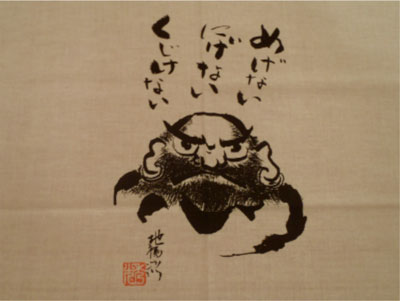
“don’t be discouraged, don’t run away, don’t let you crush”

“don’t be discouraged, don’t run away, don’t let you crush”

In Kita-Kamakura at the Engakuji Temple I talked
this March with farmers from the Fukushima area who do not give up selling local products.With admirable persistence they advertise the quality of their vegetables, pickles and other goods. I could not feel any bitterness in their attitude, as if it was their fault people all over the country are concerned about radioactive contaminated food coming from their fields, and they now have to invest double effort, double friendliness to compensate.

I felt honoured by the invitation to give a scientific talk at Tohoku University in Sendai on
March 11th this year, the day two years after the disaster occurred. All people, be it farmers or fellow scientists I met in Tohoku region during the past two years shared a sincere attitude to not give up and do their best to re-build what has been destroyed by the earthquake and tsunami.

How can they, how can the world accept such a bravery is thwarted by a few others, who’s only interest seems to be saving some money?

Update: I received some feed-back saying as a foreigner I have no right to criticise Japan’s internal business.

Don’t I have a right to worry for my Japanese friends and colleagues? And as a scientist, I may add that the age of Japan (and more generally, of civilisation and mankind) is pretty short compared to the 24,100 years half-life time of Plutonium, which is stored and was released at the Fukushima plant. Spreading radioactive material is always concerning all human beings, world-wide, for ever (regarding human measures of time).

Another remark I received is concerning the relation of discussing such matters to Zen. Should a Zen-teacher not better silently sit on his pillow and meditate for the well-being of others, or at least for his own enlightenment? The above painting was done by the head-priest of the Jifukuji-Temple in Kasenuma. I’d be curious to hear his opinion on that … I imagine the fierce-looking Daruma on the painting might open his mouth wide for a big shout.

Failure

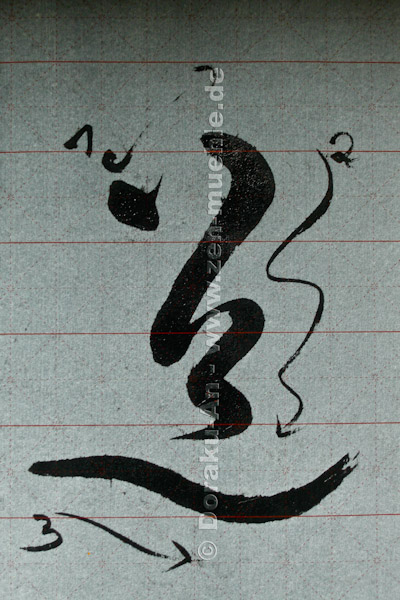
After the morning Sutra recitation the old master is beating the Kaihan (開板, a large wooden board) mounted outside the Temple to signal the beginning of the morning Zazen. The strong tok-tok-tok breaking through the dawn can for sure be heard throughout the village.

kaihanOn the Kaihan outside a Zen-Dojo often the Chinese characters for “Life” and “Death” (生 and 死) are written, sometimes with a few additional words to remind us we should make good use of the short time-span given to us.

Before going to Japan this March I was in a hurry and careless when baking my bread and overheated the sourdough in an attempt to make the yeast grow even faster to save time. The yeast died, and in the following I had two complete failures with the bread I made. Eventually I had to discard the uneatable slimy mass, the first total loss in many years of baking …

I take the sound of the Kaihan as a warning to not waste time by hurrying too much and pushing things to develop beyond their natural pace. There is no way to force a sourdough becoming a bread before its time.

Spring

Waking up by the bird’s singing, doing the choka (朝課, the morning Sutra chanting) together with the ouzel and finishing Zazen and Hitsuzendo in the break of dawn means spring is coming.

Seven months passed since last fall when I had to close my Dojo and suspended this blog. I returned to Japan and my “home temple” in Kameoka twice during this winter, for Zazen, to meet my friends and to see the old master. It was cold during Rohatsu-Sesshin (臘八接心, a very intense Zen-training period) in December and warm in late March. It was always good.

Before Summer I will open a new Dojo for practising Zazen, Hitsuzendo and Aikido. A Dojo, strong enough to survive the next winter.

Final Chores

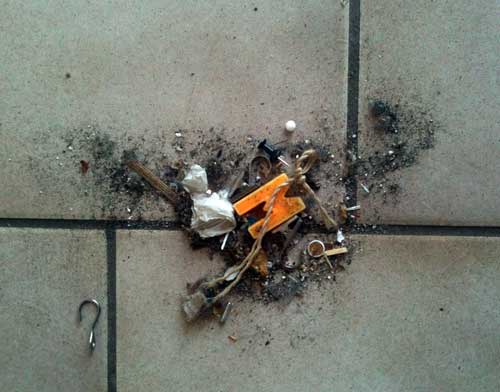
Yesterday, I did a final cleaning in my house and former Dojo before moving out. The first things I brought in three years ago were a few Zafu (pillows for Zazen) and a small Buddha statue, the last thing I moved out was a bit of dust.

dustThe “homeless” equipment of my Dojo, packed in boxes, is now piling up in the corners of a small flat.

Not having a place to practice is no problem. For the experienced, Zen-practice is possible everywhere and under all circumstances.
Not having a place to teach is more serious, since I consider not passing on what I once studied as very selfish. What you learned from your teachers is not your possession, you have to give it away as good as you can … but this is easier said than done.

Without a Dojo I also see no real need to continue this blog. The final thing to say is “many thanks” to the students who attended my seminars and sesshin, and to the readers of this blog who followed me until here.
さようなら.

Accepting Impermanence

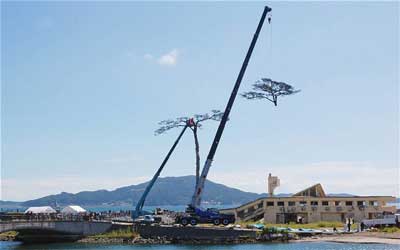
Cut into nine junks, hollowed out, given an anti-decay treatment and re-mounted on a carbon spine with plastic replica of it’s original branches, the lone surviving pine tree out of 70 000 of the Takata Matsubara forest in Rikuzentakata, Iwate Prefecture shall now be ‘preserved’.

treeFor some of my friends and colleagues in Japan this ‘miracle pine tree’ was an important symbol of hope, after the tsunami hit the shores of Fukushima prefecture.

For what will it’s zombie-fied remains stand in the future? Maybe it can become a symbol of our hopeless attempts to fight impermanence by technical means, eventually destroying what as well could be left to the cycle of birth and death, creation and decay.

Moving

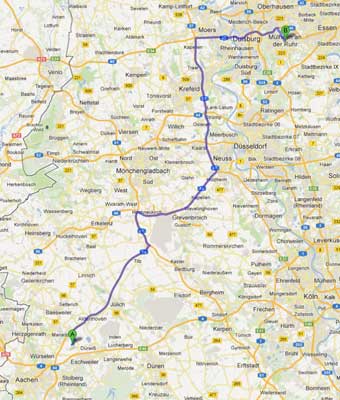
I haven’t posted much lately. The reason is that I am currently busy moving my home and Dojo to a new location (actually, the city of Mülheim an der Ruhr, not far from Düsseldorf). I feel sad that I had to give up the nice house on countryside, and especially the attic with the old wooden beams, in which the Dojo was located. Said that, I believe that leaving behind such a perfect place to practise and teach Zen is also a good lesson on impermanence …
moving
The new Dojo will be located down-town and offer regular classes on Zazen, Hitsuzendo and Aikiken during the week, in addition to day-long seminars on weekends. Location and schedule will be announced soon!

Update (Jan 2014): Finding a suitable and affordable room for my new Dojo appeared to be much more difficult than expected. I keep on searching and hope to re-open soon!

Wind and Water Calligraphy

An important aspect of life is accepting impermanence. Nothing lasts forever, although scientifically speaking changes occur at very different time scales e.g. for us humans and rocks, which make us believe that permanent things do exist. Actually, they don’t, and the only permanence is the permanent change and modification of everything.

That is why for example a key phrase in the Hannya Shingyo (般若心経) explains that form is emptiness and emptiness is form (色即是空  空即是色).

Usually I practice Hitsuzendo on used newspaper, which I scrap afterwards. I don’t much like the idea of writing a calligraphy which lasts. When playing my Shakuhachi, the sound vanishes the moment it leaves my flute, that is how I want to write: without leaving a trace.

Last year in China I wrote together with old calligraphy masters in the park using a water brush. To see our art evaporate after a few minutes was very pleasant.

shore

My calligraphy washed away.

This week I made a new discovery: an equally good canvas provides the sea shore when the tide is going out. Immersed in wind and water, to the rhythm and sound of the waves I write with a stick I pick up from the sand. A few waves later my writing is washed away and the beach is blank and polished again.

Zen Diet

This blog is sometimes a bit theoretical, I feel … so here comes some practical suggestion. My understanding of Zen is that it should support our life in all aspects.

I love eating. Since I am fortunately also quite successful at loosing weight without suffering, I am happy to
share my findings: a Zen-talk on diet.

A lot of pain and suffering is caused by overweight. Practising Zazen is just one of the activities which are difficult and potentially dangerous (for the knees and spine) with too much fat on the body. Overweight does not only shorten our lives, it also makes especially the final years much less pleasant and joyful. Since part of my scientific research is related to understanding cardiovascular diseases, I know what I am talking about. Feeling just happy with significant overweight is no plan for life, it is one of the illusions we maybe can get rid of practising Zen.

The best way to loose weight is staying at a Zen temple. I lost 3.5 kg in 7 days this spring in Japan, although I ate a lot, three times a day. A physically active daily schedule, a regular life-style and healthy food work automatically.

The next-best way is applying some science and psychology. So here my basic rules:

  • Energy balance: you must burn more energy than you intake by eating and drinking. If the energy balance is negative, you inevitably loose weight, since your body needs to compensate from it’s own savings. 1 kg of body fat are approx. equivalent to 7000 calories. That amount of energy you need to burn more than you eat, in order to reduce 1 kg. Said that, I don’t like counting calories, a “volume control” by using a small bento-box for lunch (see picture) works perfectly fine for me! And preparing a nice and healthy o-bento every day can be very motivating …
  • Insulin level: after eating carbon-hydrates, sugar (and maybe even sweeteners, though this is under discussion), the insulin level in the blood rises to help transporting energy into the body cells. In other words: it locks the exit doors to the fat reservoirs you want to burn. I avoid eating “in between”, or drinking sweet stuff (including zero calories diet drinks containing sweeteners), because this pushes the insulin level up, and I cannot efficiently burn my fat for a certain time.
  • Moving: moving burns calories, but just a little. Much more “expensive” for your body is being 24 hours prepared for physical activity: filling the reservoirs with energy and providing sufficient muscle power is very expensive. Therefore, regularly moving is an important key factor for a successful diet, far beyond the few calories you burn during the activity itself. And it prevents you from reducing your muscle volume during diet, instead of burning fat.
  • Enjoying food: eating too less brings your body into an emergency mode: all functions burning energy go to a minimum, you won’t just feel weak and bad, but also significantly reduce the ability to burn fat. When in spite of a strict diet the weight does not further reduce, this is a clear warning to eat more!
    Also, I guess it is important to appreciate and enjoy good and healthy food, which should include it’s preparation. When I am on diet, I spend lots more time with cooking and enjoy eating much more than usual. So a diet is not so much about eating less, but more about food.
  • Motivation: imagine your life after reducing weight! You’ll be a different person, and most likely much more active and healthy. For motivation, it might help to keep records of what you eat, of your morning weight, it might help to tell others and install some social control, and to visualise the amount of weight you already lost (by buckets filled with water carried upstairs once a day, if you like).
    But most important I consider the motivation to actually start developing a focus on (preparing) healthy food, and to enjoy the process of improving your life, not to focus on the final result of a diet. This kind of motivation is not for enduring a horrible time until eventually you lost a few kilos, the process itself of improving your life by new eating habits is the goal!
My today's lunch. For further inspirations on o-bento I highly recommend http://justbento.com/

My today’s lunch. For further inspirations on o-bento
I highly recommend http://justbento.com/

Another story is keeping a low weight, once reached. This is the tough part, it requires changing the whole life-style, permanently. In my case, since it is so easy for me to loose 10 or 20 kg within a few months, I usually simply forget about healthy eating after some time and go back to old habits … no good idea!

What is the link to Zen? you might ask after reading this. Some say, for reducing weight you need a strong will-power, and you must get rid of a scheme in which eating is a compensation for something else missing or going wrong in your life. I don’t know … but for sure regularly practising Zazen will help you with both aspects. In Zen, we try to do the next step right. Prepare the next meal in a suitable and healthy way, and forget about “diet”…

WARNING: The above is my personal experience and might very well work for a physically and mentally healthy adult. In case of doubt, before trying yourself better consult a medical doctor or certified diets expert (I am not!). You’ll very likely reduce weight with the above suggestions and enjoy the positive and unexpected side-effects, but you do so on your own risk!

Memorial Service

This morning I played the piece Eko (回向) on the Shakuhachi in my Dojo. Following the tradition, performing Eko is like chanting a sutra for the benefit of souls who have passed away. This morning’s Eko was dedicated to the up to 160.000 human beings killed in Hiroshima on August 6th, 1945.

Living in a region and era of relative peace, I do not want to forget that Germany is currently number three in the list of arms exporting countries. August 6th and August 9th are special memorial days, not just for Japan. Though, there are good reasons to perform Eko every day …

“Is that sufficient” one is allowed to ask “just playing the Shakuhachi?”. I wonder, what can we do acting for piece, without causing further destruction?

Dropping the atomic bombs on Hiroshima and Nagasaki is described in many history books as a well justified action to establish piece, end the pacific war and by this save many lives. Others say it was just a demonstration of power towards the Soviet Union at the onset of the cold war.

I prefer performing Eko, every day …

Only Japanese

The Japanese professor plays the cello for us. He is a skilled medical doctor and surgeon, but his cello performance is just as good as it can be after three years of practise. So we admired more his brave performance in open air public, in a country where the cello and its ancestors are at home for centuries, and maybe not so much the musical qualities of his play.

After he was finished, we talked a bit about music in general and why he is so enthusiastic about the cello. “Japanese people love classical music” he explained. When I promised to play the Shakuhachi for him in return for his cello concert next time I come to Japan, he was seriously taken aback: “Shakuhachi … that is Japanese instrument. Western people can really play …?”.

Well … maybe, if they are brave enough …? I don’t like music, I love it …