Strange Words

After the morning Zazen, we chant the Heart Sutra (Hannya Shingyo) and the Shigu Seigan Mon, accompanied by the bell and the wooden drum, Mokugyo. This is not much for a Morning Ceremony, and yet it is fair to ask, why at all do we chant texts in ancient Japanese (we maybe do not even understand)?

Although in Zen practice I usually suggest to try first, and then ask for the details of how and why, I believe there are some good reasons to stay with these old texts:

  • These two texts are kind of basic, all over the world for all Buddhist and Zen schools. In the West, we are about to find our own Way of Zen, but not always we want to break with tradition.
  • Our Zen came from Japan, and remembering and keeping alive some of its Japanese roots is o.k.
  • It is beautiful, the sound, the unification of mind and body through breath and voice! Also, chanting words which (at least for the beginner) do not make much more sense than blah blah blah does not distract the mind too much, it is a very good exercise!
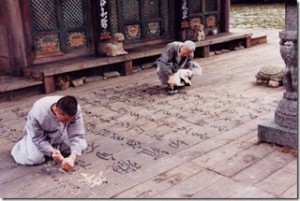
Writing the Heart Sutra with a cat's tail

Writing the Heart Sutra with a cat’s tail

Of course, the Hannya Shingyo contains some very deep meaning, and part of it is still recited in its original Pali version. But it is o.k. to ignore all this for the time being, and simply enjoy chanting with a loud voice “Maka Hannya Haramita …”

A Wall of Words

Not to talk, not to explain yourself, not verbalising your emotions, might easily seem arrogant. Or, for those experienced with therapy, indicate an inhibited character.

Not to talk, I believe, is a mercy.

These days I read an article about a New York based psychotherapist, who continued working through the whole day of September 11th, 2001. The article describes how she and her patients talked and talked, as if to mure themselves with words. Did it bring them any relieve in the face of the disaster?

“It was a total disavowal”, the therapist confessed.

What drives us to build a second world of words and ideas, instead of facing the unbearable (and often also instead of facing the bearable, which we just want to look a bit nicer)?

I remember a scene from Akira Kurosawa’s movie Rhapsodie in August, in which two old ladies, who both survived the atomic bombing of Nagasaki, met for a coup of tea without talking a word. This not talking made a great impression on the grandchildren of one of the ladies, as well as on myself.

Today’s September 11th is exactly six months after the Tohoku earthquake and tsunami. Sharing intense time, silently, is what we also do during Zazen. At times, for some of us, while bearing the unbearable.

Confusion

The first book on Zen I read was a clear, nicely written more or less unpolished transcript of the Zen-talks given in plain English by S. Suzuki to his American students (Zen Mind, Beginners Mind). After that, unfortunately, I came upon books which were very hard, if not impossible to understand. Books full of contradiction, ambiguous and mystic words, which in the end made me belief that the only chance to really understand Zen is being a Japanese Zen-monk in a Japanese Zen-temple, centuries ago.

It took me a considerable way down the road of learning the Japanese language, until I realised that much of the confusion in Zen-texts is very likely more or less just a translation problem. Let me quote Richard Feynman, the famous physicist, on the subject of learning Japanese, to illustrate that point:

While in Kyoto I tried to learn Japanese with a vengeance. I worked much harder at it, and got to a point where I could go around in taxis and do things. I took lessons from a Japanese man every day for an hour.

One day he was teaching me the word for “see.” “All right,” he said. “You want to say, ‘May I see your garden?‘ What do you say?” I made up a sentence with the word that I had just learned. “No, no!” he said. “When you say to someone, ‘Would you like to see my garden?’ you use the first ‘see.’ But when you want to see someone else’s garden, you must use another ‘see’, which is more polite.” “Would you like to glance at my lousy garden?” is essentially what you’re saying in the first case, but when you want to look at the other fella’s garden, you have to say something like, “May I observe your gorgeous garden?” So there’s two different words you have to use.

Then he gave me another one: “You go to a temple, and you want to look at the gardens…” I made up a sentence, this time with the polite “see.” “No, no!” he said. “In the temple, the gardens are much more elegant. So you have to say something that would be equivalent to ‘May I hang my eyes on your most exquisite gardens?

Three or four different words for one idea, because when I’m doing it, it’s miserable; when you’re doing it, it’s elegant […]. I gave up. I decided that wasn’t the language for me, and stopped learning Japanese.

(text taken from wikiquote)

Feynman was not a stupid person, and politeness, confusing as it may sound in the above quotation, is yet a solvable issue. Much more severe is the lack of a subject in many Japanese sentences (this is to be derived form the politeness level), and (compared to any European language I know) a much greater ambiguity of many expressions.

What does that mean for our understanding of (the English translation of) some ancient writings on Zen? Although the ancient Masters’ life and actions were clear and exemplary to his students, his writings skills might not have been on the same level. Adding to that a time distance of a few centuries and the above mentioned language and translation issues, even a plain description how to wash your bowl might in the end sound like a nebulous spiritual revelation of some deep secrets. It is not. It is just written communication gone wrong …

If some Zen-text does not make sense to you, don’t waste too much time on trying to understand it by reasoning! Don’t expect a deep secret behind the words, don’t get frustrated and don’t try to sound clever by quoting what you did not understand yourself … better spend your time in practising a few rounds of Zazen!

Total Freedom

Do you remember what was driving us, when we were young? Before changing the life insurance policy and fixing the garage roof were an issue, before we started fighting about what could be an appropriate, but not too expensive return gift when visiting the Smiths?

The sky was the limit, the sky and beyond, nothing could stop us. And nowadays, we have to allocate time the next week-end to finish our tax declaration, or …

I don’t accept the priority we often tend to give to all these necessities, and also not, that giving all up and following some or any rules set up by someone leads to salvation. Our life is too short and our true friends are too few to waste our time!

winehousePractising Zazen is not, by any means not, a noble exercise which makes us somehow better, or distinguishes us from the masses wasting their lives in front of the TV or by working too hard to increase their affluence. Zazen is a way to survive, when us adult people reached a state of living in the moment, as we maybe, hopefully, once did as teenagers.

Having a heart like a child and the experience of an adult, the sky and the world are wide wide open to us, and we can freely enjoy life or burn and die so quickly.

My daughter recently called me to tell me that Amy Winehouse died. “Amy Who?” I asked … but later listening to her voice, I wished she practised some Zazen, just to survive her incredible presence for a few more years.

Two Leaves

I happened to leave London the night the riots started, which some described as a fight for new sneakers and the latest iPad, others as a consequent social explosion. Avarice, envy and frustration might be major reasons to let us do things, we normally would never accept to happen.

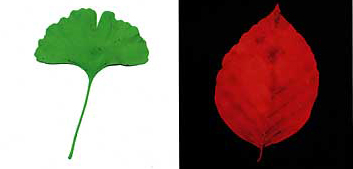
leavesMy next stop was Weimar, the cradle of what is known as the Weimar Classicism. Bach, Wieland, Herder, Goethe, Schiller, the genius pianist and generous teacher Franz Liszt, the Bauhaus opening the horizons of contemporary architecture; all of them are closely linked to Weimar, which nowadays merchandise its (at their time not always welcome) geniuses with the symbol of the ginkgo leaf, celebrated in Goethe’s well known poem.

chimney

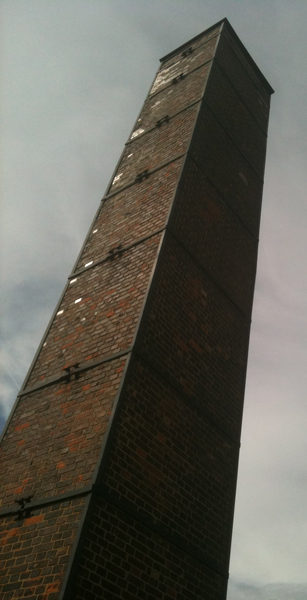
Chimney of the Buchenwald
concentration camp crematory.

Another leaf is closely linked to Weimar, that of the beech tree. The concentration camp Buchenwald is located just a Sunday afternoon coffee trip’s distance away, and within a few years as many Gentlemen were murdered in Buchenwald, as inhabitants the city of Weimar counts. The incredibly sadist way this happened filled my eyes with tears while visiting the crematory (in spite of heaving learnt all the facts many years ago at school).

How does it go together, the ginkgo leaf and the beech leaf? What answer does Zen offer?

As far as the official and approved successors of Buddha are concerned, I have not much hope. Slaughtering our Chinese brothers and sisters in Nanking, and later justifying the massacre as a good service towards their salvation, since their premature death gives them a chance to be re-born as something better, bares the same barbarian spirit of Buchenwald. The Japanese ginkgo and the German beech are brother and sister in that aspect.

What can we do?

Zen teaches us of no difference. There is not them, the evil murderers, us, the good ones. Practising Zazen also means asking myself, who is me, able to heading the Buchenwald concentration camp, slaughtering and burning myself in the crematory. Who is me, able to killing myself in Nanking.

Not taking the opportunity to rob or rape or kill the human being next to me is a cultural achievement, we should not easily underestimate. Zazen is only worth the time spent on our pillow, if it supports us in this effort, understanding me as the culprit, and the victim.

There is no “right way of living amidst the wrong” (“Es gibt kein richtiges Leben im falschen”) the German Philosopher Adorno wrote in his Minima Moralia under the impression of the fascist terror. Zen is the effort of creating a way of living, moment by moment, in spite of all circumstances. And be it nothing more than to wash our bowl after eating. Or maybe (getting back to the cause of the London riots), share some of it’s content, instead of eating all up alone.

Zen and Food

Filling the monks’ empty stomach is a very important task, so the Tenzo or chef of a Zen temple is a highly respected person. The duty of being Tenzo is for sure a good chance to develop not only one’s cooking and logistic skills, but also one’s compassion, since most of the time and energy is devoted for others’ well-being.

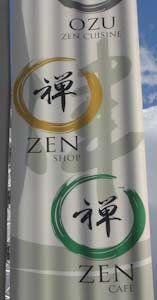
zen1That’s why I had a this-is-not-really-o.k. kind of feeling, when I discovered a restaurant (Japanese, Chinese and coffee-shop) next to the London Eye. The location is boasting with the name “Zen”, and using a (seemingly computer generated) Zen-circle (Enso) enclosing the Japanese character “Zen” 禅 as a logo.

A real touch of Zen, I experienced later in a small restaurant called “Tokyo Dinner”. It is a truly amazing little piece of Japan, located in London Cinatown. The quality of service and food is on the level (or above) of what I enjoyed in Japan (and hardly ever in Europe), at very affordable prices.

tokyodinnerNot mentioning “Zen” anywhere (and possibly even embarrassed by my comparison), you can learn about a Tenzo’s Zen-heart, when you read Tokyo Dinner’s statement “Why no tuna?”. Or if you just go there and taste yourself!

A Coup of Tea

The first ideas about Eastern Philosophy came to me through movies. There was the Star Wars from George Lucas (I wrote about in an earlier post), and as an elementary school kid I watched the TV series Kung Fu, telling the adventures of a Shaolin Monk (performed by David Carradine).

Me and my friends did not much like the fighting scenes,  since (hard to imagine today), using your feet and legs, even during most severe fights in the school-yard, was absolutely banned as being girlish and mean. But I was much impressed by the hardships the young novices had to endure, before they were allowed to enter the temple.

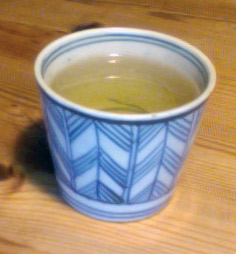
My beloved Japanese tee-cup.

My beloved Japanese tee-cup.

Especially one scene engraved in my early memory: when a few selected boys, after waiting outside the temple for days, were eventually let in and offered tea. Thirsty as they were, all kids drank immediately, all except the one, who was then allowed to stay in the temple: he waited, until the old master put up his cup …

The message, the little boy I was back then took from watching Kung Fu on TV: aside from paying a certain amount of respect, observing your seniors with full attention is the best (if not only) chance to learn something from them!

Today, fortunately, a first encounter with Zen and Zen-Arts is possible through authentic teacher, not just the TV. But watch out, when the old master offers his young want-to-be student some tea!

A Good Day ?

“Every Day is a Good Day” is a common English translation of the Japanese proverb 日々是好日 (often pronounced nichi nichi kore ko jitsu).

I came across nichi nichi kore ko jitsu around the time my interest in Zen and Calligraphy became more serious, and assumed it must describe an advanced state of mind (maybe after Enlightenment), when whatever happens to you is just good.

Alas, after years of practice, I still experienced a considerable number of bad days. I started to hate this “Every Day is a Good Day”, since it reminded me every day of my very limited progress. Not even my number of good days significantly increased!

This must be part of Orwell’s Newspeak, I finally concluded, where by erasing certain words (“bad day”) one attempts to re-define the reality, well in opposite to the obvious facts.  “Every Day is a Good Day” is simply a lie, which does not become more true when repeating it over and over again! No matter its source is the famous collection of koan, called Blue Cliff Record (Hekiganroku)

But eventually, I realised that the third Japanese character in the proverb, namely the 好 (“ko”), has a variety of connotations, aside of the usual “good”. It is often used in a sense of “to like” or “to have an intimate relation with”. Composed of the two elementary characters for “women” (女) and “child” (子), it maybe evokes the intimate relation of mother and child: an unconditional, fundamental affection, but not a statement about “good” or “bad”. Actually, (most) parents love their kids, also on days when they do something bad!

Understood this way, the 好 (“ko”) has an active component, of to like something, or to be engaged in a friendly, affirmative relation with something. It reflects my personal, emotional attitude!

Nowadays, I translate 日々是好日 (nichi nichi kore ko jitsu) as “Every Day is Welcome”, or “I Like every Day”, be it a bad or a good day!

Winning a Competition

Yesterday, the Japanese team won the women’s Football World Cup. Against whom did they win?

In case you have a chance to visit the Engakuji Temple in Kita-Kamakura, let me suggest to leave the beaten track and turn left before passing through the big wooden Sanmon-gate uphill. You will find a small sub-temple, which functions as a Kyudo Dojo (a place to practice Japanese archery).

Isn’t archery exemplary for sports competition, winning or loosing, hitting the bull’s eye or failure?

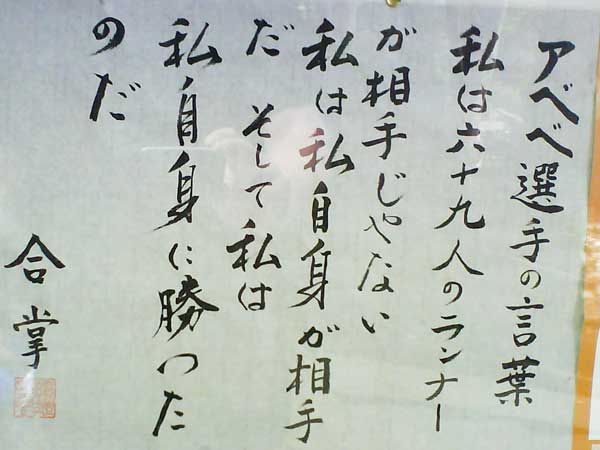
The answer is given by the head-master of the Kyudo Dojo, the old priest Suhara Koun (I was so lucky to meet and talk to several times during my visits the past decade). In the show-case right hand side after entering the Dojo grounds, he hung a newspaper article about the 1960 and 1964 Olympic marathon winner Abebe Bikila. 

abebe

Suhara Koun quoted in his own calligraphy from that article:

Words of the athlete Abebe: The other 69 runners were not my competitors, I myself was my competitor. Therefore, I won against myself.

Congratulations to the Japanese soccer team, for not giving up in the face of disaster and invincible opponents, and winning the World Cup competition against themselves!

Lost in Beauty

Gion Matsuri, one of three big festivals in Kyoto, will be at it’s peak from tomorrow on. It always makes me a bit sad, not to be in Kyoto around this time! The streets are crowded with cheerful people, you can hear the ancient festival music played everywhere from the floats, and the scent of delicious food is in the air. After the end of the rainy season Kyoto gets steamy hot with a humidity close to saturation, the typical Kyoto-in-the-summer atmosphere!

gionmatsuri

I remember strolling down Shijo-street towards Kamogawa-river with my friends, watching a dance performance, and later in the evening arriving at Yasaka-shrine next to Gion. Many many times I have been walking that route the past decade, but it is never as pleasant as during Gion Matsuri in the evening, when the streets are reserved for pedestrians, and all Kyoto seems to crowd within a few blocks of the old down-town.

Being at my Dojo in the cold and rainy north-west of Germany right now (we had 17 degrees Celius maximum today), it does not help much longing for Kyoto, for the warmth and beauty of Gion Matsuri.

Better gardening a bit in the rain, I believe, instead of dreaming of a warm festival somewhere else!  Not some other place, some other time … right here, right now is our Zen-mind! Though, still, it is so beautiful …